Eric Hovind is the son of Kent Hovind, who was another prominent Christian speaker. Although I would prefer not to mention it, because in most cases it is immaterial, I have to for the purposes of explanation: Kent Hovind was sentenced to 10 years in federal prison in 2007. Afterwards, Eric Hovind decided to learn from Kent's arguments, presentations and debate skills and continue his father's work -- an admirable feat, I have to say.
Sye Ten Bruggencate is also a prominent Christian speaker who has debated other atheists and scholars, although he mainly lays his arguments out online. His parents immigrated from Holand to Toronto, and he now currently still lives in Ontario. I think the only honest way to represent who Sye Bruggencate is is by using the final sentence on the about me page on his website: "By God's grace alone, I am a Christian."
 |
| The Amazing Randi is always in his prime. |
As for the Reason Rally, it was a large meeting for religious skepticism and secularism back in 2012 at the National Mall.
The video in question, in my opinion, was disgusting in many ways. Eric Hovind's position, as he described, was that we cannot know anything without God, because in order to be absolutely certain about anything, we must know everything (since, if we didn't know everything, we wouldn't know if there is evidence to invalidate the things we think we know). Randi, I think, succinctly responded to his questions, and Hovind thanked him for his time, but not before letting his friend Sye Bruggencate get one final question. After buttering Randi up for a few seconds and showering him with compliments, he asked the question: "how do you know your reasoning is valid?" If you want Randi's response, I suggest watching the video. I believe he answered honestly and sufficiently, but Sye's objection was that Randi was using his reasoning to validate his reasoning, and that this is "viciously circular." Randi stated his unwillingness to continue because the exchange was "juvenile," and Sye gave a snarky dismissal to the crowd: "See, this is what happens when you challenge them to validate their reasoning" all while pointing to Randi and looking at the camera. This was disgusting, and incredibly disrespectful to someone as great as Randi.
Now, of course, this video is from April of 2012, so why am I complaining about it now? The reason (no pun intended) is because I want to try to respond to Sye's question. Of course, when I want to answer philosophical questions which might lead me to an existential crisis, I look to my dad's writings for inspiration, and no surprise, he didn't let me down; thus, the title of this post is labeled under "Dad's Work," but not the implications thereafter. Those are my own. I've also run this by many other people who I think are very rational, reasonable thinkers, and we've all tweaked the arguments so that they can respond to any potential objections.
So once again, the question is "how do you know your reasoning is valid?" This is, immediately, a self-destructive statement. The person asking the question has to use their reasoning to articulate that question in a way the respondent can understand, and the same applies to the respondent -- the question must be asked and answered using reason. It is impossible to give Sye a satisfying answer without using reason; it's impossible for me to even explain all of this without using reasoning, therefore, reasoning is shown to be valid. In actuality, this question is self-destructive at every single level, so let's examine every facet of the question's implications.
First, we have to define "reasoning" and "validity." Here, I will define "reasoning" as having to subscribe to the laws of thought, and "validity" as not eventually leading to a contradiction. Note: a non-contradictory statement may be valid, but it may also be incorrect. The truth of a claim is different from the validity of the claim. However, if we accept this definition of validity (and it widely is accepted as such), then we have to ask: why is that the definition? It's because validity itself is a concept which is only defined under the laws of thought, or reasoning. To ask "is reasoning valid" is like asking "is truth true?" Once again, it's self-destructive, because I cannot validate something without accepting reasoning.
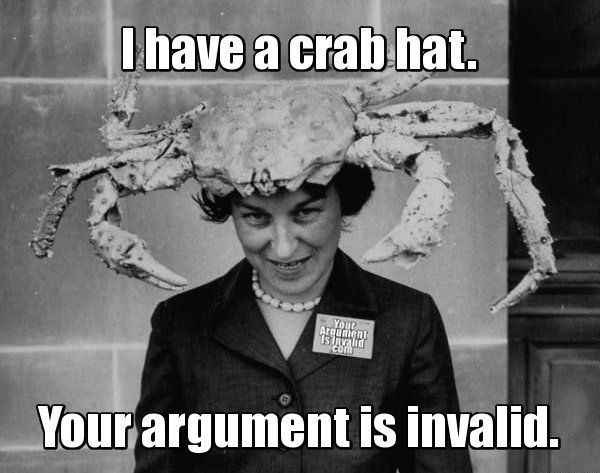 |
| The operations of unreasoning. |
At the same time, without rationality, we can conclude both A and Not A at the same time, since contradictions are no longer an issue. For example, I can conclude that I am a cat and that I am not a cat at the same time, and because they are only contradictory under logic and reasoning, they are "valid" under irrationality.
So, given that we can conclude anything from anything under the operations of irrationality, let us begin using the only thing we know to be true right now, which is our provisional assumption: that irrationality, illogicality and unreasoning is "valid." Because the provisional assumption is true, I can conclude anything else under the confines of irrationality. So, I will conclude that reasoning is valid.
"Wait a second, you can't do that-" but I can. Because we are not confined to reasoning, I can conclude whatever the heck I want from any fact. If reasoning were invalid, and therefore unreasoning were valid, then I can conclude any fact (B) from any fact (A). I just chose to make fact (B) "reasoning is valid," and fact (A) "unreasoning is valid." We cannot complain about a non sequitur since reasoning is invalid, and we cannot complain about a contradiction for the same reason.
"So, what's the point? You can't complain that it's a contradiction because you've already said that reasoning is invalid." Exactly, I can't complain it's a contradiction; however, I can say, then, that reasoning is valid. Because unreasoning is valid, reasoning is valid. This is a very unreasonable conclusion, and thus it is "valid" under the confines of irrationality. Therefore, we can conclude that even if reasoning were invalid, reasoning would still be valid -- it is literally impossible for reasoning to be invalid.
I should note, as well, that although we were operating under the confines of unreasoning, how do we know that we could reach that conclusion if we were to accept that unreasoning were "valid," as it were? We had to use reasoning to do so. Once again, at every instance, the question is self-destructive. It is literally impossible for reasoning to be invalid, and we didn't need divine revelation to come to this conclusion.
 |
| Debate: Bill Nye thinks: "Are you kidding me?" |
First, we must establish something: that if any axiom or facet of the laws of thought were to fail, then all of the laws of thought as a whole would fail as well. We can validate this in two ways: (1) by analogy; and, (2) by definition.
My analogy is this: we have a platform that is supported by ten pillars. Each pillar must be made of concrete in order to support the weight of the platform. This being said, only nine of the pillars are made of concrete, while the tenth pillar is made of something weaker: wood, clay, feathers, whatever you want. We can say, therefore, that because this one pillar is flawed, that the structure of this object (the platform supported by the pillars -- we'll call it a tent) is flawed as a whole, because it fails to be "perfect" in every respect. The tent cannot be flawless while something in its structure is flawed.
Similarly, we can say the same about the laws of thought, but the definition itself means we have to accept all axioms or none of them. The purpose of the laws of thought and reasoning is to be applicable in every situation -- if we were to find any instance, any bubble where the laws of thought didn't apply, that means there is a situation where being illogical is valid, and thus the laws of thought would fail, because they are not universally binding (binding, in the sense, that they are always applicable, not that we always have to follow them -- there will always be irrational thinkers in the world).
So, if we were to show that one axiom is invalid, then we could not accept the laws of thought in their entirety. How are we going to apply this to Ken Ham's question?
 |
| Look at this picture and ignore everything else. |
The statement "I am always hungry" is inherently valid, because it doesn't necessarily contradict itself. Throughout my life, I have constantly been eating, and there has never been a single time where I was not hungry, and the same will be true in the future, and for all intents and purposes, eternity. If we were to pair it with things like "I will die" and "when I die, I will no longer be hungry," then it would be contradictory, but by itself, it is not contradictory, and therefore is valid. Therefore, we can assume things about the nature of hunger in order for that statement to be valid. One such thing is that the nature of hunger (and by extension our current reasoning) has always been the same.
Consider it like this: in order for the statement "I am always hungry" to be valid, we have to assume both that the nature of hunger has always been the same, and that the nature of reasoning has always been the same. If the nature of reasoning were not the same at some point in the past, then we couldn't make inferences about the past such as with the statement "I am always hungry," and thus temporal logic would be invalid. Let's test this with another provisional assumption: that the nature of hunger was different 5,000 years ago from what it is today. By extension, since the nature of being hungry (and therefore, in at least one instance, the nature of "being") was different at some point in the past, then the nature of reasoning changes from past to present. We cannot make inferences about that point in the past using our reasoning today, then, because they are not consistent with each other. This means that temporal logic will fail to make valid inferences about that point in the past, where the state of nature was quite different from what it is today, and thus temporal logic in itself becomes invalid. Since we have established that in order for the laws of thought to be valid, all of its axioms must be valid, then because temporal logic fails, logic in its entirety fails.
This is what happens when we wonder if the very state of being for certain things was different back then from what it is now -- we find self-destruction. We can state with certainty, then, two things:
(1) That reasoning is valid.
(2) That reasoning has always been valid, and always will be valid, in order for reasoning today to be valid.
We can represent this symbolically too: let (I) be "reasoning is valid," let (W) be "reasoning was valid" and let (B) be "reasoning will be valid."
1. I
We know this to be true because we have already constructed a proof which shows that reasoning has to be valid.
1. I
2. (~W v ~B) --> ~I
This says if either (W) is not true or if (B) is not true, then (I) is not true. We constructed a proof for this as well using temporal logic as the case example. So, let's start with our provisional assumption (PA) -- that reasoning was not valid in the past.
1. I
2. (~W v ~B) --> ~I
3. ~W [PA]
We can then use the rule of addition (ADD) to create the syntax we need to apply Line 2:
1. I
2. (~W v ~B) --> ~I
3. ~W [PA]
4. ~W v ~B [3, ADD]
The reason we can do this is because of what the statement says. Line 4 says "either it is true that ~W, or it is true that ~B." Since we know it is true that ~W, then that statement is true, because at least one of the two variables is true. So now that we have the syntax, we can use Modus Ponens to conclude the assumptions of Line 2.
1. I
2. (~W v ~B) --> ~I
3. ~W [PA]
4. ~W v ~B [3, ADD]
5. ~I [2, 4, MP]
If our PA (that reasoning was not valid in the past) is true, then we can conclude that reasoning is not valid in the present. In actuality, this was the longer proof. There is an easier explanation.
Remember earlier where we proved that reasoning has to be valid no matter what? Well if we think creatively, we can just apply it to thinking in the past or the future. If, at any given point in the past, reasoning was invalid, then the proofs we showed would have to take effect. If, at any point in the past, someone asked these same questions, they would still be able to draw the same conclusions (assuming that everyone in the past knew the laws of thought, which they didn't).
 |
| The word of "God" comes at a cost. |
Thank you all for reading.
Follow me on social media!
Twitter: https://twitter.com/AlexisDelanoir
Google+: https://plus.google.com/+AlexisDelanoir0/
YouTube: https://www.youtube.com/AlexisDelanoir