This evening, Spawktalk, who goes by the name of Sean Last for The Right Stuff (TRS), wrote a rebuttal to my first post on the topic of race, "Lewontin's Fallacy" and Race. As I explained in the comments on his article, I've opted not to reply for a multitude of reasons, but am still interested in writing a reflection on the discussion we had. First, though, I want to talk about my experiences reading the article first.
Having been familiar with the kind of articles TRS produces, I was honestly a bit nervous. They're typically, even as Sean admitted, quite inflammatory and hostile, especially towards liberals (which, I suppose, is what they might see me as, though I'd disagree). I was surprised to find that the only things that caused my brow to furrow while reading his article were the title (which Michael Enoch admitted was not Sean's doing) and the subtexts under the pictures (which were funnier than they were offensive). It was a pleasant surprise, although it really shouldn't have been. My exchange with Sean was quite friendly, and so I shouldn't have suspected his rebuttal to be much different.
The comments were even more surprising, at least initially. My experiences on TRS have told me that the commenters can and will be very vicious in their responses, and can quickly reject any type of reasoned discussion in exchange for aggression and toxicity. This was by far not the case tonight. The commenters were friendly, gracious, and quite nice to speak to. As one commenter expressed, it was a real breath of fresh air. As I said there as well, there's no reason that people of different views can't have a friendly discussion. While this was initially the case, now the comments seem to have devolved into the typical exchange I'd expect there. It's a shame, but what can you do?
To reflect on the discussion itself, it was quite enjoyable. Sean brought up some interesting points, and there were moments where I had to concede to his arguments, and ultimately I took away some new perspectives; namely how race realists typically define "race." To Sean, race does retain a degree of arbitration, and it is only one of a multiplicity of ways in which someone can examine human genetic variation. I came to realize this isn't entirely inconsistent with my own views; the conclusions we draw, however, regarding the significance of racial categories, or whether or not those categories are objective or biological in nature, is what we ended up having to agree to disagree on.
A lot of the points in the article seemed to be things I've addressed already, either in response to commenters or in sections of my other posts on the topic. Sean and I do fundamentally disagree on one factor which I think is important to bring up. Say, for example, that the social ramifications of racial categories is what has caused group differentials in IQ. To Sean, this is still a validation of race as a human taxonomy. To me, this is evidence of social construction, specifically not of biological validation. I don't see us reconciling this difference in interpretation, but I think it's interesting to note the stark contrast between the conclusions we drew from the same point. It just further shows the complication behind this subject.
Sean also brought up a point about the AAA, AAPA and HGP's definitions of race, and how they are problematic given race realists' definition of race. I absolutely agree, and I emailed the AAA on their article expressing my concerns. I've yet to receive a reply, and so I hope others will ask too, demanding a higher priority on the question. At the same time, Sean and I disagree on our trust in these organizations. I trust the consensus view of anthropologists while Sean is cynical of them. While I believe that these organizations have a much greater advantage in terms of access to scientific literature regarding the subject, Sean believes our access is comparable to theirs. Again, I suppose we'll have to agree to disagree on these points.
I don't think that Sean fully understands what I mean when I talk about the social or cultural construction of race, and so I'll clarify my views here. When one speaks about the social construction of race, we are drawing attention to its origins, its modern usage, and its social ramifications. One could argue that all things are socially constructed, but this is usually very uninformative. For example, we can talk about the social construction of a hammer; however, hammers were explicitly invented by humans, and so we naturally define what it is and what qualifies as a hammer. We could also talk about the social construction of grass, but this has a pretty universal consensus. Having said all of that, I do not believe that "race" as a general taxonomy is overwhelmingly a social construct. When I say that race is a social construct, I mean that our decision as to what groups of humans qualify as different races is socially constructed; that is, the classification itself is not overwhelmingly a social construct, but what people we choose to put into that classification (for humans, anyway) is. Another way to put it: race is "a culturally constructed label that crudely and imprecisely describes real variation" (Relethford 2009). I love that quote.
If I think of anything else to say about our exchange, I'll just keep adding it onto this post. All in all, I enjoyed the past two months of discussion over this topic, though there were major time gaps between our replies. I think that Sean puts a lot of thought into the responses he makes, and as I stated on his article, I greatly respect his intellect and passion for the subject. He seems to be, to me, an intellectually honest person, and I hope that he dedicates his time and effort to a related field of study later on in his career. While I personally believe racial categorization is problematic and mostly uninformative, there is no reason to stop someone who disagrees from contributing to the academic discussion over this issue. Our disagreement is based on our experiences, and so a shared experience in the future might bring us and like-minded individuals closer to an agreement.
Thank you all very much for reading.
Showing posts with label Race. Show all posts
Showing posts with label Race. Show all posts
Saturday, December 6, 2014

Wednesday, September 24, 2014
Evolution: Common Misconceptions, or "What Evolution Is Not"
I've recently been reading a book by Agustín Fuentes, Race, Monogamy, and Other Lies They Told You: Busting Myths about Human Nature with my girlfriend. We're only through part 1 (and the prelude of part 2), but it's an incredible read thus far, and I highly recommend it to anyone who is serious about their research in anthropology, evolution or human variation. Dr. Fuentes lays out a "toolkit," in his own words, on how to bust myths about human nature by applying the principles of genetics and culture to three common pervasive myths found in our society: (1) human race; (2) inherent human aggression; and, (3) sex.
Chapters 2 and 3 struck me well, but chapter 3 "Evolution Is Important -- but May Not Be What We Think," was especially informative and helpful. Dr. Fuentes starts off with a quote by popular science writer Nicholas Wade, who has recently come under fire for his book A Troublesome Inheritance: Genes, Race and Human History. The quote is from an article in the New York Times, and it says the following:
Of course, many people in the public hold the beliefs that Wade is referring to; however it simply isn't true that the primary debate amongst informed scholars is over whether or not evolution is happening in humans or, as some people often misinterpret, that evolution "stopped at the neck" in humans.
This objection refers to the debate over the Black/White IQ differential, specifically the position that most, if not all of the variation in IQ results between these two groups is a result of the environment. The problem with the characterization "evolution stopped at the neck," however, is that just because someone doesn't believe the differential is a result of evolutionary or genetic differences, that doesn't mean they don't believe human cognition has evolved. Evolution is complex, and even someone who suggests that the differential is a result of evolution doesn't necessarily mean it was a product of adaptation or natural selection. This is a gross oversimplification of how evolution works, and what the real debate entails, and thus we should now move into the five common misconceptions about evolution that are popularly held by the public.
1: Evolution is "survival of the fittest."
I can't tell you how many times I've heard this implication. To begin, Charles Darwin never used the phrase "survival of the fittest" -- this concept otherwise known as "social Darwinism" is attributable to Thomas Hobbes and Adam Smith. The concept is an interpretation of one aspect of evolution: natural selection. Natural selection is Darwin's process of "descent with modification," and states that some gene variants will help an organism reproduce more successfully, and that if these variants are heritable, they will become more common within a population over time. These variants are then seen as adaptations to a specific environmental context.
What this means is that "the fittest" doesn't necessarily mean the biggest, baddest or strongest. It's specific to an environment, where "the fittest" may be the exact opposite. Consider an easy example: the field mouse. It is not the fastest creature in the world, it is not the strongest, it does not have a serious bite, and it poses pretty much no risk to any creature of any size bigger than itself. So why does it continue to succeed and reproduce? Because "bigger" does not mean "better." Speaking of better, this brings us to the second misconception about evolution.
2: Evolution results in perfection.
As Fuentes notes, evolution is not oriented towards progress, nor does it result in organisms fitting perfectly with their environment. To quote, "The corollary to this is that if something works well we perceive it as having 'evolved' for this particular purpose."
Evolution is not perfect -- it's sloppy, and isn't geared towards making something ultimately "better." When an organism has traits which allow it to successfully reproduce in its environment, and these traits are a result of evolution, it does not mean that it evolved that way for a purpose.
3: Evolution happens by chance.
There is only one aspect of evolution that represents "chance," and that would be genetic drift. Genetic drift suggests that random events can sometimes alter the allelic frequencies of a population. Fuentes offers an example of this: take hair color. There is a small population living on an island with hair color gene A, and there are three alleles of the gene: A1, A2 and A3. Say the population is made up of 80% A1, 10% A2 and 10% A3. Now, imagine that most of the population lives on the north coast of the island, and that part of the island is hit by a major tsunami. Now, the only people remaining are the smaller numbers of people on the south end of the island, changing the allelic frequency to maybe 33% for all alleles of the hair color gene A. This results in evolutionary change, but not because of anything having to do with the genes or the alleles themselves, but with a random event which drastically changed the makeup of the organisms in the population. Genetic drift, then, is most potent in smaller populations, because random events are less likely to have significant effects on larger populations.
But as said, this is the only aspect of evolution that relies on randomness or chance. There are three other major components of evolution: gene flow, natural selection and mutation. We've already explained natural selection. Mutation is the means by which organisms gain new genetic material, where it creates a new sequence in a gene that produces a protein or regulation that functions better than previously. Gene flow is the movement of alleles within and between populations as a result of migration. The allelic frequencies within and between two populations can change if the populations are close enough together that allows for migrations between them. The allelic frequencies between the two populations can either become more similar if there's enough gene flow or, if gene flow is restricted, they can remain the same. Gene flow, natural selection, and mutation, then, do not occur by chance, but have multiple reasons for occurring.
4: If something has evolved in a certain way, that is how it should be.
This one is a bit complicated, but it's similar to misconception #2. Basically the idea is that if an organism exhibits a certain trait, and that trait is a result of evolutionary change, then the exhibition of that trait is the way things are supposed to be. This is not necessarily true, because there are many things that have occurred via evolutionary means, but were intended for a different purpose than what they're used for today. This is called exaptation.
One beautiful example of this is bird feathers. Originally, bird feathers evolved as a structure of temperature regulation. The feathers on a bird's wings allowed it to trap air underneath, allowing it to either cool off by lifting its wings up, or warm up by bringing its wings in. At some point, the wings on some birds became substantial enough that they were able to glide, and this unintended function resulted in reproductive success. Now, wings are used for flying. This is a perfect example of something that occurred through evolutionary processes, but did not serve the function it does now, thus showing that even if something has evolved does not mean it was intended to be what it is today.
5: Evolution can stop, has an end, or has a goal.
This is our last misconception. Evolution does not stop; it is always ongoing. Evolution is also not goal-oriented -- it doesn't have a goal, and it doesn't seek perfection. Something that has occurred by evolutionary means is not the finish line, and it is not more "natural" than other things. Traits that have evolved are the result of any number of processes that can and will continue to act on us and every other organism over the course of time.
These misconceptions overlap in many ways, but are very applicable to modern times. It's commonly held that if something has evolved, or if something is engrained in our biology, then that is "correct" or "natural." This is the basic premise of human nature which Dr. Fuentes argues against. Just because something is biological or evolutionary does not mean it is any more natural than any other aspect of our lives. The premise of this idea is that, for example, between our biology and our society, biology takes precedence as we cannot avoid its grasp, and our society or social situation can change. This simply isn't the case, though: our biology is constantly changing, and the strength of our genes is not more powerful than the strength of our environment.
Creationists, determinists, indeterminists, racialists, and many other groups of people will commonly fall into the belief in one of these misconceptions as part of their arguments. Be equipped and well-informed of what evolution is and is not so that these misconceptions can be further dispensed, and the core of the arguments can be reached instead of the nuances of what evolution does or does not imply.
And above all, thank you very much for reading.
Follow me on social media!
Twitter: https://twitter.com/AlexisDelanoir
Google+: https://plus.google.com/+AlexisDelanoir0/
YouTube: https://www.youtube.com/AlexisDelanoir
Chapters 2 and 3 struck me well, but chapter 3 "Evolution Is Important -- but May Not Be What We Think," was especially informative and helpful. Dr. Fuentes starts off with a quote by popular science writer Nicholas Wade, who has recently come under fire for his book A Troublesome Inheritance: Genes, Race and Human History. The quote is from an article in the New York Times, and it says the following:
"Many have assumed that humans ceased to evolve in the distant past, perhaps when people first learned to protect themselves against cold, famine and other harsh agents of natural selection. But in the last few years, biologists peering into the human genome sequences now available from around the world have found increasing evidence of natural selection at work in the last few thousand years, leading many to assume that human evolution is still in progress."The quote reflects on two popular misconceptions held by the public about evolution, which we will get to in a moment. It's important to note first, though, that this illustrates more than just misconceptions about evolution, but a lack of understanding in even the educated public, and the necessity of a false dichotomy. As Dr. Fuentes points out, "To sell the story, the false representation of a 'debate' as to whether evolution happens in humans has to be a central theme."
Of course, many people in the public hold the beliefs that Wade is referring to; however it simply isn't true that the primary debate amongst informed scholars is over whether or not evolution is happening in humans or, as some people often misinterpret, that evolution "stopped at the neck" in humans.
This objection refers to the debate over the Black/White IQ differential, specifically the position that most, if not all of the variation in IQ results between these two groups is a result of the environment. The problem with the characterization "evolution stopped at the neck," however, is that just because someone doesn't believe the differential is a result of evolutionary or genetic differences, that doesn't mean they don't believe human cognition has evolved. Evolution is complex, and even someone who suggests that the differential is a result of evolution doesn't necessarily mean it was a product of adaptation or natural selection. This is a gross oversimplification of how evolution works, and what the real debate entails, and thus we should now move into the five common misconceptions about evolution that are popularly held by the public.
1: Evolution is "survival of the fittest."
I can't tell you how many times I've heard this implication. To begin, Charles Darwin never used the phrase "survival of the fittest" -- this concept otherwise known as "social Darwinism" is attributable to Thomas Hobbes and Adam Smith. The concept is an interpretation of one aspect of evolution: natural selection. Natural selection is Darwin's process of "descent with modification," and states that some gene variants will help an organism reproduce more successfully, and that if these variants are heritable, they will become more common within a population over time. These variants are then seen as adaptations to a specific environmental context.
What this means is that "the fittest" doesn't necessarily mean the biggest, baddest or strongest. It's specific to an environment, where "the fittest" may be the exact opposite. Consider an easy example: the field mouse. It is not the fastest creature in the world, it is not the strongest, it does not have a serious bite, and it poses pretty much no risk to any creature of any size bigger than itself. So why does it continue to succeed and reproduce? Because "bigger" does not mean "better." Speaking of better, this brings us to the second misconception about evolution.
2: Evolution results in perfection.
As Fuentes notes, evolution is not oriented towards progress, nor does it result in organisms fitting perfectly with their environment. To quote, "The corollary to this is that if something works well we perceive it as having 'evolved' for this particular purpose."
Evolution is not perfect -- it's sloppy, and isn't geared towards making something ultimately "better." When an organism has traits which allow it to successfully reproduce in its environment, and these traits are a result of evolution, it does not mean that it evolved that way for a purpose.
3: Evolution happens by chance.
There is only one aspect of evolution that represents "chance," and that would be genetic drift. Genetic drift suggests that random events can sometimes alter the allelic frequencies of a population. Fuentes offers an example of this: take hair color. There is a small population living on an island with hair color gene A, and there are three alleles of the gene: A1, A2 and A3. Say the population is made up of 80% A1, 10% A2 and 10% A3. Now, imagine that most of the population lives on the north coast of the island, and that part of the island is hit by a major tsunami. Now, the only people remaining are the smaller numbers of people on the south end of the island, changing the allelic frequency to maybe 33% for all alleles of the hair color gene A. This results in evolutionary change, but not because of anything having to do with the genes or the alleles themselves, but with a random event which drastically changed the makeup of the organisms in the population. Genetic drift, then, is most potent in smaller populations, because random events are less likely to have significant effects on larger populations.
But as said, this is the only aspect of evolution that relies on randomness or chance. There are three other major components of evolution: gene flow, natural selection and mutation. We've already explained natural selection. Mutation is the means by which organisms gain new genetic material, where it creates a new sequence in a gene that produces a protein or regulation that functions better than previously. Gene flow is the movement of alleles within and between populations as a result of migration. The allelic frequencies within and between two populations can change if the populations are close enough together that allows for migrations between them. The allelic frequencies between the two populations can either become more similar if there's enough gene flow or, if gene flow is restricted, they can remain the same. Gene flow, natural selection, and mutation, then, do not occur by chance, but have multiple reasons for occurring.
4: If something has evolved in a certain way, that is how it should be.
This one is a bit complicated, but it's similar to misconception #2. Basically the idea is that if an organism exhibits a certain trait, and that trait is a result of evolutionary change, then the exhibition of that trait is the way things are supposed to be. This is not necessarily true, because there are many things that have occurred via evolutionary means, but were intended for a different purpose than what they're used for today. This is called exaptation.
One beautiful example of this is bird feathers. Originally, bird feathers evolved as a structure of temperature regulation. The feathers on a bird's wings allowed it to trap air underneath, allowing it to either cool off by lifting its wings up, or warm up by bringing its wings in. At some point, the wings on some birds became substantial enough that they were able to glide, and this unintended function resulted in reproductive success. Now, wings are used for flying. This is a perfect example of something that occurred through evolutionary processes, but did not serve the function it does now, thus showing that even if something has evolved does not mean it was intended to be what it is today.
5: Evolution can stop, has an end, or has a goal.
This is our last misconception. Evolution does not stop; it is always ongoing. Evolution is also not goal-oriented -- it doesn't have a goal, and it doesn't seek perfection. Something that has occurred by evolutionary means is not the finish line, and it is not more "natural" than other things. Traits that have evolved are the result of any number of processes that can and will continue to act on us and every other organism over the course of time.
These misconceptions overlap in many ways, but are very applicable to modern times. It's commonly held that if something has evolved, or if something is engrained in our biology, then that is "correct" or "natural." This is the basic premise of human nature which Dr. Fuentes argues against. Just because something is biological or evolutionary does not mean it is any more natural than any other aspect of our lives. The premise of this idea is that, for example, between our biology and our society, biology takes precedence as we cannot avoid its grasp, and our society or social situation can change. This simply isn't the case, though: our biology is constantly changing, and the strength of our genes is not more powerful than the strength of our environment.
Creationists, determinists, indeterminists, racialists, and many other groups of people will commonly fall into the belief in one of these misconceptions as part of their arguments. Be equipped and well-informed of what evolution is and is not so that these misconceptions can be further dispensed, and the core of the arguments can be reached instead of the nuances of what evolution does or does not imply.
And above all, thank you very much for reading.
Follow me on social media!
Twitter: https://twitter.com/AlexisDelanoir
Google+: https://plus.google.com/+AlexisDelanoir0/
YouTube: https://www.youtube.com/AlexisDelanoir
Wednesday, April 30, 2014
Racialized Medicine: Prophecies for Profit
A few days ago, on a website I recently joined, I was faced with an interesting comment regarding my position on race. The comment read as follows:
Of course, the commenter was unaware of the fact that I have addressed many arguments concerning race before, so to say that these "differences in populations" have not been addressed is pretty funny. In actuality, the entirety of this comment was a goldmine, but considering that I've addressed much of it before, and that there's really too much to consider in a single post (without boring everyone to death), I decided to narrow down my focus to "responses to medications;" or in other words, race-targeted medicine. The answer to this question, actually, can be applied to a lot of between-group differences regarding race, so this is an important case to look at. The idea, as the moniker implies, is that certain racial/ethnic groups respond differently to medications, and thus pharmaceutical/medical treatment should take race/ethnicity into consideration when treating patients.
If we were to take a look at the data, we might be convinced that this is the case. For example, Burroughs et al. (2002) writes:
There are two problems with such a conclusions: (1) the parameters; and, (2) the use of race as a proxy.
By parameters, I mean how "race" is defined in these studies which show racial/ethnic disparities in responses to medical treatment. Much of my knowledge on race is informed by the special 2009 edition of the American Journal of Physical Anthropology entitled "Race Reconciled: How Biological Anthropologists View Human Variation." It's incredibly informative, and for anyone who is willing to sit through some of the jargon (much like I may end up doing), I would highly recommend it. In any case, it's thus only appropriate that I refer to Gravlee (2009), "How race becomes biology: Embodiment of social inequality." Gravlee writes:
In the absence of definition, we can only assume that we are looking at the traditional racial/ethnic categories that are used in the United States. This is problematic for reason 2 as stated above: that in these studies, race is used as a substitute for individual genotypes based on tested averages. Of course, this is a terrible proxy due to the complexity and nested pattern of human diversity. As Long et al. (2009) writes:
Hunley et al. (2009) comes to the same general conclusions, but tackles the idea of racialized medicine with their findings:
Practitioners who use race as a substitute for the true genetic explanations behind their results are making a grave mistake, and so are drug companies, because they are severely underestimating the true degree of diversity in different populations, especially sub-Saharan Africa. That being said, race is a horrible substitution for known alleles and genotypes. Thankfully, individual DNA analysis has become quite cheap over the years, and offers much more insight for individualized treatment.
Unfortunately, failures such as BiDil are ultimately going to be swatted at back and forth by the left and right, because scandals such as these are profitable, inspire research for the pharmaceutical field, and fans the flames of debates over race and "political correctness."
So, in summation:
(1) In biomedical research, race is hardly defined, if at all;
(2) To answer the question: "why do races respond differently to medical treatment," the answer is, we don't know if they really do;
(3) Using race as a mean for individual genotypes and alleles ignores the pattern of human diversity and the staunch differences within populations; and,
(4) Race-targeted medicines are honestly just prophecies for profits despite the much cheaper, more accurate use of individual DNA testing.
To conclude, I think it's interesting that individuals such as the commenter I am replying to, who are so skeptical of mainstream science, do not suspect the foul play going on here, simply for the fact that it seemingly validates the biological concept of race. This doesn't mean, however, that variation doesn't exist, and this is a point I've repeated many times in the past. As Relethford 2009:20 writes, race is "a culturally constructed label that crudely and imprecisely describes real variation." The possibility that our DNA is affecting our responses to medical treatment is definitely there; but race, as it stands, is a bad representation of this genetic variation.
Thank you for reading.
Follow me on social media!
Twitter: https://twitter.com/AlexisDelanoir
Google+: https://plus.google.com/+AlexisDelanoir0/
YouTube: https://www.youtube.com/AlexisDelanoir
 References:
Burroughs VJ, Maxey RW, & Levy RA (2002). Racial and ethnic differences in response to medicines: towards individualized pharmaceutical treatment. Journal of the National Medical Association, 94 (10 Suppl), 1-26 PMID: 12401060
Gravlee, C. (2009). How race becomes biology: Embodiment of social inequality. American Journal of Physical Anthropology, 139 (1), 47-57 DOI: 10.1002/ajpa.20983
Hunley, K., Healy, M., & Long, J. (2009). The global pattern of gene identity variation reveals a history of long-range migrations, bottlenecks, and local mate exchange: Implications for biological race. American Journal of Physical Anthropology, 139 (1), 35-46 DOI: 10.1002/ajpa.20932
Long, J., Li, J., & Healy, M. (2009). Human DNA sequences: More variation and less race. American Journal of Physical Anthropology, 139 (1), 23-34 DOI: 10.1002/ajpa.21011
Relethford, J. (2009). Race and global patterns of phenotypic variation American Journal of Physical Anthropology, 139 (1), 16-22 DOI: 10.1002/ajpa.20900
"Basically the definition [of race] here you've given me is from the New Left. Unsurprisingly, its adherents do not address the differences in populations relating to genetics, responses to medications, vulnerabilities to disease, or incompatibilities with cross-group transplantation. To say that there are no differences between human population groups is either a flagrant lie or indicates you have been raised in a cave by wild hogs."
Of course, the commenter was unaware of the fact that I have addressed many arguments concerning race before, so to say that these "differences in populations" have not been addressed is pretty funny. In actuality, the entirety of this comment was a goldmine, but considering that I've addressed much of it before, and that there's really too much to consider in a single post (without boring everyone to death), I decided to narrow down my focus to "responses to medications;" or in other words, race-targeted medicine. The answer to this question, actually, can be applied to a lot of between-group differences regarding race, so this is an important case to look at. The idea, as the moniker implies, is that certain racial/ethnic groups respond differently to medications, and thus pharmaceutical/medical treatment should take race/ethnicity into consideration when treating patients.
If we were to take a look at the data, we might be convinced that this is the case. For example, Burroughs et al. (2002) writes:
"The recent report of the Institute of Medicine (IOM), "Unequal Treatment: Confronting Racial and Ethnic Disparities in Healthcare;" illustrates in eloquent scientific detail that racial and ethnic disparities in health care do exist and are prevalent in both the treatment of medical illness and in the delivery of care services to minorities in the United States." (Burroughs et al. 2002:1)
There are two problems with such a conclusions: (1) the parameters; and, (2) the use of race as a proxy.
By parameters, I mean how "race" is defined in these studies which show racial/ethnic disparities in responses to medical treatment. Much of my knowledge on race is informed by the special 2009 edition of the American Journal of Physical Anthropology entitled "Race Reconciled: How Biological Anthropologists View Human Variation." It's incredibly informative, and for anyone who is willing to sit through some of the jargon (much like I may end up doing), I would highly recommend it. In any case, it's thus only appropriate that I refer to Gravlee (2009), "How race becomes biology: Embodiment of social inequality." Gravlee writes:
"Racial-genetic determinism persists in part because of the uncritical use of race in biomedical sciences and public health. Systematic reviews in health-related disciplines show that race is widely used--appearing in ~80% of recent articles--but that it is seldom defined (Anderson and Moscou, 1998; Drevdahl et al., 2001; Comstock et al., 2004; Gravlee and Sweet, 2008). For example, in three independent reviews of literature in genetics (Sankar et al. 2007), infant mortality research (Anderson and Moscou, 1998), and health services research (Williams, 1994), not a single article defined race." (Gravlee 2009:49)
In the absence of definition, we can only assume that we are looking at the traditional racial/ethnic categories that are used in the United States. This is problematic for reason 2 as stated above: that in these studies, race is used as a substitute for individual genotypes based on tested averages. Of course, this is a terrible proxy due to the complexity and nested pattern of human diversity. As Long et al. (2009) writes:
"[...] a classification that takes into account evolutionary relationships and the nested pattern of diversity would require that Sub-Saharan Africans are not a race because the most exclusive group that includes all Sub-Saharan African populations also includes every non-Sub-Saharan African population." (Long et al. 2009:32)
Hunley et al. (2009) comes to the same general conclusions, but tackles the idea of racialized medicine with their findings:
"Our findings confirm that broad ethnic categories employed in medical genetic research might not adequately take into account the complex geographic pattern of genetic structure in the species, but for the same reason, neither may continental ancestry. This is because our results also indicate that substantial, potentially medically important genetic differences may exist between populations within regions." (Hunley et al. 2009:45)
Practitioners who use race as a substitute for the true genetic explanations behind their results are making a grave mistake, and so are drug companies, because they are severely underestimating the true degree of diversity in different populations, especially sub-Saharan Africa. That being said, race is a horrible substitution for known alleles and genotypes. Thankfully, individual DNA analysis has become quite cheap over the years, and offers much more insight for individualized treatment.
Unfortunately, failures such as BiDil are ultimately going to be swatted at back and forth by the left and right, because scandals such as these are profitable, inspire research for the pharmaceutical field, and fans the flames of debates over race and "political correctness."
So, in summation:
(1) In biomedical research, race is hardly defined, if at all;
(2) To answer the question: "why do races respond differently to medical treatment," the answer is, we don't know if they really do;
(3) Using race as a mean for individual genotypes and alleles ignores the pattern of human diversity and the staunch differences within populations; and,
(4) Race-targeted medicines are honestly just prophecies for profits despite the much cheaper, more accurate use of individual DNA testing.
To conclude, I think it's interesting that individuals such as the commenter I am replying to, who are so skeptical of mainstream science, do not suspect the foul play going on here, simply for the fact that it seemingly validates the biological concept of race. This doesn't mean, however, that variation doesn't exist, and this is a point I've repeated many times in the past. As Relethford 2009:20 writes, race is "a culturally constructed label that crudely and imprecisely describes real variation." The possibility that our DNA is affecting our responses to medical treatment is definitely there; but race, as it stands, is a bad representation of this genetic variation.
Thank you for reading.
Follow me on social media!
Twitter: https://twitter.com/AlexisDelanoir
Google+: https://plus.google.com/+AlexisDelanoir0/
YouTube: https://www.youtube.com/AlexisDelanoir
References:Burroughs VJ, Maxey RW, & Levy RA (2002). Racial and ethnic differences in response to medicines: towards individualized pharmaceutical treatment. Journal of the National Medical Association, 94 (10 Suppl), 1-26 PMID: 12401060
Gravlee, C. (2009). How race becomes biology: Embodiment of social inequality. American Journal of Physical Anthropology, 139 (1), 47-57 DOI: 10.1002/ajpa.20983
Hunley, K., Healy, M., & Long, J. (2009). The global pattern of gene identity variation reveals a history of long-range migrations, bottlenecks, and local mate exchange: Implications for biological race. American Journal of Physical Anthropology, 139 (1), 35-46 DOI: 10.1002/ajpa.20932
Long, J., Li, J., & Healy, M. (2009). Human DNA sequences: More variation and less race. American Journal of Physical Anthropology, 139 (1), 23-34 DOI: 10.1002/ajpa.21011
Relethford, J. (2009). Race and global patterns of phenotypic variation American Journal of Physical Anthropology, 139 (1), 16-22 DOI: 10.1002/ajpa.20900
Monday, April 14, 2014
Mailbag: Clearing the Air Anthropologically
I noticed that there are, in addition to the things already discussed, a few questions regarding some of the things I've said having to deal with anthropology; thus, I decided it'd be best if I made another short mailbag post to clear the air.
The first two questions are responding to my post on "Lewontin's Fallacy" and Race, but since these (unlike what I'm used to) are constructive and very clearly objective, I'm going to reply to them despite my having ended any discussion on that post. First:
This email is two things: (A) completely correct; and, (B) a great talking point. It is entirely true that the most up-to-date data in anthropology supports the multiregional hypothesis. The difference between these two hypotheses is that Out of Africa supported the large-scale replacement hypothesis, in that it suspected that modern humans who migrated out of Africa replaced the existing human populations such as the Denisovans and the Neanderthals with little-to-no intermixing involved; however, recent evidence suggests the contrary, that some populations can have as much as 4% Neanderthal admixture. I actually had a brief discussion with somebody on my debate page comments regarding this. These findings do support a multiregional hypothesis (not a candelabra model) because the multiregional hypothesis suggests a series of migrations and back-migrations with substantial intermixing with existing human populations, thus resulting in a widespread, complicated network of human interaction and gene flow.
Often times, I conflate the multiregional hypothesis with the candelabra model for online debates because, considering who I'm debating against, they often do not know the difference, and if I were to tell them I supported the multiregional hypothesis but still believed human race does not exist, they would not understand why. Interestingly enough, the implications of the multiregional hypothesis suggest that Neanderthals and Denisovans are of the same species as Homo Sapiens, but perhaps different subspecies or races. That hurts the debate a little.
But, I'm willing to accept that I was incorrect in my framing of the debate, and I apologize to anyone who I misled. Knowing now that there are legitimate interest readers who look into the true science of what I write about on occasion, I'll do my best to improve my writing so that it is factually accurate, not socially convenient.
Next question.
I defend my support of Lewontin and Gould for different reasons. Lewontin's research was genuinely the birth of research which would serve to debunk traditional racial categories at the genetic level. Gould was rejected by many scientists in the last decade because of the Morton-Gould War. Neither Lewontin nor Gould deserve to be rejected, but of course, we need more recent and relevant data to defend our position.
Since I want to keep this short, I'll only include one more question:
You know, when I hear the phrase "human nature," I and many people in the field of anthropology let out a heavy sigh and put our fingers in between our eyes in frustration; but then, the words of Tim Ingold echo in my ears, and not only is my headache put at ease, but in all honesty, the eloquent phrasing of Ingold's argument makes my heart throb a little:
If you asked anthropologists today what their favorite quote was, I think many of them would pick this one out. The suggestion that a person, or a society's culture can be predetermined by their genes is absolutely ridiculous.
Thank you all for your input. Look forward to more
Follow me on social media!
Twitter: https://twitter.com/AlexisDelanoir
Google+: https://plus.google.com/+AlexisDelanoir0/
YouTube: https://www.youtube.com/AlexisDelanoir
The first two questions are responding to my post on "Lewontin's Fallacy" and Race, but since these (unlike what I'm used to) are constructive and very clearly objective, I'm going to reply to them despite my having ended any discussion on that post. First:
"Ms. Delanoir, I noticed that on your post on Lewontin and Race, you said that the general scientific consensus is in support of the Out of Africa hypothesis. This really isn't true anymore (although it may have been back in 2010 or 2011). Indeed, anthropologists do support the multiregional hypothesis, which is not to be confused with the candelabra model. Is this why you were confused?"
This email is two things: (A) completely correct; and, (B) a great talking point. It is entirely true that the most up-to-date data in anthropology supports the multiregional hypothesis. The difference between these two hypotheses is that Out of Africa supported the large-scale replacement hypothesis, in that it suspected that modern humans who migrated out of Africa replaced the existing human populations such as the Denisovans and the Neanderthals with little-to-no intermixing involved; however, recent evidence suggests the contrary, that some populations can have as much as 4% Neanderthal admixture. I actually had a brief discussion with somebody on my debate page comments regarding this. These findings do support a multiregional hypothesis (not a candelabra model) because the multiregional hypothesis suggests a series of migrations and back-migrations with substantial intermixing with existing human populations, thus resulting in a widespread, complicated network of human interaction and gene flow.
Often times, I conflate the multiregional hypothesis with the candelabra model for online debates because, considering who I'm debating against, they often do not know the difference, and if I were to tell them I supported the multiregional hypothesis but still believed human race does not exist, they would not understand why. Interestingly enough, the implications of the multiregional hypothesis suggest that Neanderthals and Denisovans are of the same species as Homo Sapiens, but perhaps different subspecies or races. That hurts the debate a little.
But, I'm willing to accept that I was incorrect in my framing of the debate, and I apologize to anyone who I misled. Knowing now that there are legitimate interest readers who look into the true science of what I write about on occasion, I'll do my best to improve my writing so that it is factually accurate, not socially convenient.
Next question.
"Alexis,
First, I would like to thank you deeply for your contributions to fighting race revival. Sometimes I look back on the progress we've made in anthropology and think 'where did we go wrong?' In any case, I just have a few minor comments.
You spent a little bit of time defending your citation of both Lewontin and Gould (in separate posts), and I'm just wondering if there's a specific reason you're doing so. In all honesty, even I acknowledge in this debate that citing Lewontin or Gould is kind of remedial, and I often look at it and think 'is that all you got?' There are many other, much more recent authorities and studies to cite that effectively prove the same point. One good place to start would be with this article:
http://www2.webmatic.it/workO/s/113/pr-1400-file_it-Barbujani-Colonna.pdf
If you're interested in more, let me know!"
I defend my support of Lewontin and Gould for different reasons. Lewontin's research was genuinely the birth of research which would serve to debunk traditional racial categories at the genetic level. Gould was rejected by many scientists in the last decade because of the Morton-Gould War. Neither Lewontin nor Gould deserve to be rejected, but of course, we need more recent and relevant data to defend our position.
Since I want to keep this short, I'll only include one more question:
"I noticed that a lot of issues you're having with people in the race debates have to deal with this mistaken idea that human behavior and phenotypes can be predetermined by their genes. Do you think that there's some inherent human nature that we cannot overcome?"
You know, when I hear the phrase "human nature," I and many people in the field of anthropology let out a heavy sigh and put our fingers in between our eyes in frustration; but then, the words of Tim Ingold echo in my ears, and not only is my headache put at ease, but in all honesty, the eloquent phrasing of Ingold's argument makes my heart throb a little:
"Human capacities are not genetically specified but emerge within processes of ontogenetic development. Moreover the circumstances of development are continually shaped through human activity. There is consequently no human nature that has escaped the current of history.
[...] This does not mean, of course, that a human being can be anything you please. But it does mean that there is no way of describing what human beings are independently of the manifold historical and environmental circumstances in which they become–in which they grow up and live out their lives."
If you asked anthropologists today what their favorite quote was, I think many of them would pick this one out. The suggestion that a person, or a society's culture can be predetermined by their genes is absolutely ridiculous.
Thank you all for your input. Look forward to more
Follow me on social media!
Twitter: https://twitter.com/AlexisDelanoir
Google+: https://plus.google.com/+AlexisDelanoir0/
YouTube: https://www.youtube.com/AlexisDelanoir
Tuesday, March 25, 2014
Mailbag: Race, Gene Clusters and Wright's FST
About a week ago, the storm over my most recent post on race finally settled down, and I found myself with a bit of peace. Then I received this email:
Should I give up, or should I try explaining again? (I'm kidding of course -- I only act this way because I think I know who sent the email, and that's what makes it funny).
First of all, the biggest warning sign that I can be given in these discussions is, right off the bat, being accused of censorship. The accusation isn't entirely untrue, but it isn't perfectly descriptive either. I control the comments that come into my blog because I write on controversial topics from time to time, and thus am inevitably going to receive comments that are NSFW. I don't want that, although I don't go ape over people swearing on my blog either -- I'm rather liberal when it comes to those sorts of things. I do like to keep the discussions in check, though. Anyone who freely comments on my blog can attest to this: if you have something worth saying, you can take the time to type it somewhat cordially so that I can permit it; otherwise, it's not getting published.
Aside from that, however, when a comment doesn't introduce any new arguments (and by this, I mean the answers to their arguments are given in the post or in other comment responses), then it's not worth my readers' time to publish that comment. This is just to avoid repetition.
However, in some cases, something can be repeated so many times in so many different ways. This leads me to believe that the question is in need of an extensive reply, such as the one I am about to provide. So, without further ado, let's get to the substance of S.T.'s email. S.T. states that he sympathizes with this comment from my post on Lewontin's Fallacy and Race:
Had S.T. continued to read on, he would have seen my reply to this commenter:
This is a little vague due to the fact that I had to condense it to have a more comment-appropriate length. It also doesn't directly respond to the argument that if multiple characteristics or genes correlate with an identifiable group, then that group is meaningful in nature, and in this case, these groups can be classified as races; more so, my reply argues against the conflation of population with race. The former, more or less, is what S.T. and the commenter he quoted were arguing. In any case, I probably would've ignored this email had I not received several of the same nature:
Thus, I have decided that it is worth responding to in whole. This will be a two-part response: (1) don't gene clusters imply that we can classify race; and (2) since other subspecies have been classified with a lower FST than 0.25, doesn't that mean it works just fine with humans?
The first part is a little ignorant. If I were to compare the elk population in Alberta to the elk population in Ontario and conducted an Analysis of Molecular Variance (AMOVA) and found their FST to be 0.01, that means that only 1% of the variation which exists can be explained by between-population differences. Now, within this 1%, there may be a cluster of a few genes which almost always correlate to the elk population we took our sample from. Let's say it's a set of 25 genes. Around 95% of the time, allele A of these genes is exclusive to the Albertan Elk, and allele B is exclusive to the Ontarian Elk. The logic of what is being suggested is that because this difference exists, even though there is only a 1% difference between these two populations, we can classify them into subspecies, or race, or deme, or whatever classification below the level of species you prefer.
So, even if the FST of humans were 0.003, if that 0.3% of variation contains alleles which almost always correlate with our traditional understanding of race, then those races are meaningful classifications in the context we're discussing. By this logic, I could divide Americans from the north and Americans from the south into different races; or, as I have suggested previously, I could identify a few dozen different races in India. The issue is not whether or not there are differences. The issue is whether or not the large majority of these differences can be best explained by our traditional racial classifications. Scientists have largely found that it is not so.
The second part is a bit trickier. There are probably subspecies that have been identified which have an FST of lower than 0.25. The general rule, as I've been taught, is that 25% between-population differentiation warrants separate classification. There are always going to be exceptions to these rules, because science itself needs to be somewhat flexible in order to account for things we don't fully understand. In these cases, we would look at the Albertan Elk and Ontarian Elk and see if there are other differences. Are they geographically separated, or do they regularly move between the borders of Alberta and Ontario? Do they have distinct ecology -- does one only eat a certain type of plant, or display a different social structure?
The different "races" of humans are not so distinct. We can all adapt to living in a different society than where we grew up in without too much difficulty. We are all capable of eating the same foods, for the most part (I'm aware that, for example, lactose intolerance occurs at higher rates in some populations). We show little genetic distinction from one another (more recent estimates suggest that our differences are in the range of 3% to 7% as opposed to the 15% I usually cite). Based on our current understanding of human variation, race is not the best classification we can use.
More over, the chart that was cited in the third email I received was an interesting one. It has been cited before on my blog -- specifically, it was cited by the person that the first emailer referred to. I know which website it came from, but specifically I don't know who created it. I guess it's safe to assume that the author of that website probably made it, but I wonder if it came from a journal article instead. Either way, there are many things that I find funny/interesting about the chart, and I think I'll be discussing those things in a separate post in the near future. For now, my general explanations are what I have to offer.
What other emails have I received regarding the debate over race?
Recently, HannibaltheVictor13 on YouTube made a video response to this, and if you don't like how I say things, maybe you'll like him. You can find his video here.
Otherwise, I'll continue to respond.
Stephen Jay Gould's original thought of Morton was, yes, that Morton was a racist and that he may have shown his bias in his calculations. The direct criticism, however, was that Morton had not controlled for sex or stature of the skeletons that he observed, and that he omitted certain skulls to fit his preconceptions of racial categories, and all of this skewed the results. In their study, Lewis et al. made the same mistake Morton did and failed to control for sex or for stature. In fact, Lewis et al. failed to remeasure the entire collection -- they remeasured about half of it.
At the same time, it's funny that this email should mention and refer to Janet Monge. She was one of the researchers in the Lewis et al. study, and she is also the curator of the Physical Anthropology Section of the University of Pennsylvania Museum of Archaeology and Anthropology; this is where the skull collection is held and was being held at the time of the study. The skull collection at the University of Pennsylvania is impressive, and the university wanted to publicly promote this collection in pride. When Stephen Jay Gould criticized the measurements of the skulls in the collection, and Janet Monge responded by participating in a study to respond to Gould's criticisms, funded by the University of Pennsylvania, she immediately triggered a conflict of interest. In the study, the authors declared no competing interests. Thus, as it stands, Gould's original criticisms were intellectually sound, and the criticisms of the Lewis et al. study remain brushed under the carpet.
But either way, the flaw with this criticism of Stephen Jay Gould (one which Libertarian Realist took part in) is that it's fallacious. Stephen Jay Gould, even if he had incorrectly criticized Morton, was a great scientist, and his work was phenomenal. One fault in his addressing of human variation, specifically race, would not destroy all of the other contributions he's made to science.
This concludes this mailbag post. The next one will be about more personal questions I've received regarding my life, not my work.
Thank you all for reading.
Follow me on social media!
Twitter: https://twitter.com/AlexisDelanoir
Google+: https://plus.google.com/+AlexisDelanoir0/
YouTube: https://www.youtube.com/AlexisDelanoir
"It seems that you are censoring comments on both of your posts on race, and so I thought I would send you this email with my thoughts on the discussion. It seems to me that you are playing a semantics game over racial classification. I could talk about gene clusters and morphological characteristics that easily correlate with our traditional idea of race, but to sum it up, I sympathize with this commenter:
'In other words, they evolved differently, but we shouldn't be calling them different races anyway because liberals get butthurt... Great argument against race, no doubt. You can call them populations, I'll call them race - same thing.'
Ignoring the political rhetoric, this commenter has the right idea. By the very nature of what a category is, if we can find that there are several characteristics which correlate with our traditional understanding of race (i.e. Europeans are much more likely to have light skin, light hair, light eyes, certain tooth shape, skull shape, etc.) then even if there are occasional overlaps, those categories are useful and cannot be ignored. This is why it seems, to me, that there is not much scientific reason to deny race. You fully acknowledge that certain people evolved in certain ways to adapt to their environments, such that Europeans became different from East Asians, but you somehow say that these groups cannot be called races? That convinces me you are not scientifically motivated.
Furthermore, in one of your comments on YouTube, you stated that in order to be classified into subspecies, an animal must have an FST of 0.25 - 0.3. This is a common mistake cited by race deniers. There is no set requirement for FST to be classified into subspecies because of the errors in estimating FST, and because it is arbitrary to set any certain requirement. There are plenty of subspecies which have been identified which have an FST of lower than 0.25. There is no set rule, so despite humans having an FST of around 0.15, classifying them into subspecies is just fine.
I hope you will give me an honest response.
- S.T."
Should I give up, or should I try explaining again? (I'm kidding of course -- I only act this way because I think I know who sent the email, and that's what makes it funny).
First of all, the biggest warning sign that I can be given in these discussions is, right off the bat, being accused of censorship. The accusation isn't entirely untrue, but it isn't perfectly descriptive either. I control the comments that come into my blog because I write on controversial topics from time to time, and thus am inevitably going to receive comments that are NSFW. I don't want that, although I don't go ape over people swearing on my blog either -- I'm rather liberal when it comes to those sorts of things. I do like to keep the discussions in check, though. Anyone who freely comments on my blog can attest to this: if you have something worth saying, you can take the time to type it somewhat cordially so that I can permit it; otherwise, it's not getting published.
Aside from that, however, when a comment doesn't introduce any new arguments (and by this, I mean the answers to their arguments are given in the post or in other comment responses), then it's not worth my readers' time to publish that comment. This is just to avoid repetition.
However, in some cases, something can be repeated so many times in so many different ways. This leads me to believe that the question is in need of an extensive reply, such as the one I am about to provide. So, without further ado, let's get to the substance of S.T.'s email. S.T. states that he sympathizes with this comment from my post on Lewontin's Fallacy and Race:
"In other words, they evolved differently, but we shouldn't be calling them different races anyway because liberals get butthurt... Great argument against race, no doubt. You can call them populations, I'll call them race - same thing."
Had S.T. continued to read on, he would have seen my reply to this commenter:
"Yes, some people 'evolved' differently from others. I say this because humans are still evolving, and it seems we will be for some time to come. Again, this doesn't warrant biological classification beyond the point of subspecies. "Race" and "geographic population" are not the same thing. The significance of studying geographic populations is in observing the population's interaction with its environment."
This is a little vague due to the fact that I had to condense it to have a more comment-appropriate length. It also doesn't directly respond to the argument that if multiple characteristics or genes correlate with an identifiable group, then that group is meaningful in nature, and in this case, these groups can be classified as races; more so, my reply argues against the conflation of population with race. The former, more or less, is what S.T. and the commenter he quoted were arguing. In any case, I probably would've ignored this email had I not received several of the same nature:
"Alexis,
If you scientifically believe races do not exist in the human species, please explain how we can look at gene clusters which express for morphological differences or otherwise in populations and accurately classify them into groups?"
"I think it's dishonest to say that typically, a subspecies classification requires a 0.25-0.30 FST, or that this applies to race. Plenty of subspecies have been identified which do not have such a high FST, and in fact have a substantially lower FST than humans. I'd suggest you look at this chart:
http://occidentalascent.files.wordpress.com/2013/12/fsthe3.png?w=640&h=625
To clarify, I don't believe you're dishonest, just that you're misled, by the way. You seem very intelligent."
Thus, I have decided that it is worth responding to in whole. This will be a two-part response: (1) don't gene clusters imply that we can classify race; and (2) since other subspecies have been classified with a lower FST than 0.25, doesn't that mean it works just fine with humans?
The first part is a little ignorant. If I were to compare the elk population in Alberta to the elk population in Ontario and conducted an Analysis of Molecular Variance (AMOVA) and found their FST to be 0.01, that means that only 1% of the variation which exists can be explained by between-population differences. Now, within this 1%, there may be a cluster of a few genes which almost always correlate to the elk population we took our sample from. Let's say it's a set of 25 genes. Around 95% of the time, allele A of these genes is exclusive to the Albertan Elk, and allele B is exclusive to the Ontarian Elk. The logic of what is being suggested is that because this difference exists, even though there is only a 1% difference between these two populations, we can classify them into subspecies, or race, or deme, or whatever classification below the level of species you prefer.
 |
| Since elk in Washington tend to be fatter, they're obviously a new subspecies. |
The second part is a bit trickier. There are probably subspecies that have been identified which have an FST of lower than 0.25. The general rule, as I've been taught, is that 25% between-population differentiation warrants separate classification. There are always going to be exceptions to these rules, because science itself needs to be somewhat flexible in order to account for things we don't fully understand. In these cases, we would look at the Albertan Elk and Ontarian Elk and see if there are other differences. Are they geographically separated, or do they regularly move between the borders of Alberta and Ontario? Do they have distinct ecology -- does one only eat a certain type of plant, or display a different social structure?
The different "races" of humans are not so distinct. We can all adapt to living in a different society than where we grew up in without too much difficulty. We are all capable of eating the same foods, for the most part (I'm aware that, for example, lactose intolerance occurs at higher rates in some populations). We show little genetic distinction from one another (more recent estimates suggest that our differences are in the range of 3% to 7% as opposed to the 15% I usually cite). Based on our current understanding of human variation, race is not the best classification we can use.
More over, the chart that was cited in the third email I received was an interesting one. It has been cited before on my blog -- specifically, it was cited by the person that the first emailer referred to. I know which website it came from, but specifically I don't know who created it. I guess it's safe to assume that the author of that website probably made it, but I wonder if it came from a journal article instead. Either way, there are many things that I find funny/interesting about the chart, and I think I'll be discussing those things in a separate post in the near future. For now, my general explanations are what I have to offer.
What other emails have I received regarding the debate over race?
"Alexis,
In your review of Stephen Jay Gould's 'The Book of Life,' you suggested that he was some kind of phenomenal scientist that was revolutionary to his field. This is where you're wrong, and I'm guessing this is where you received much of your education on human racial differences. Libertarian Realist did a good video on this in response to c0nc0rdance, who I see you're subscribed to on Youtube. Funny, huh?
Stephen Jay Gould was charged with intellectual dishonesty for his book 'The Mismeasure of Man' due to his anti-racism, much like you. He accused Samuel Morton of intellectual dishonesty and bias in his calculation of cranial capacities; however, when Lewis et al. remeasured the sample from the original study, they found that Morton was completely accurate, and if anyone was biased, it was Gould.
You can find Janet Monge's interview on the matter here: http://www.youtube.com/watch?v=9oE_mVLH8fU"
Recently, HannibaltheVictor13 on YouTube made a video response to this, and if you don't like how I say things, maybe you'll like him. You can find his video here.
Otherwise, I'll continue to respond.
Stephen Jay Gould's original thought of Morton was, yes, that Morton was a racist and that he may have shown his bias in his calculations. The direct criticism, however, was that Morton had not controlled for sex or stature of the skeletons that he observed, and that he omitted certain skulls to fit his preconceptions of racial categories, and all of this skewed the results. In their study, Lewis et al. made the same mistake Morton did and failed to control for sex or for stature. In fact, Lewis et al. failed to remeasure the entire collection -- they remeasured about half of it.
 |
| S.J.G. -- a man who is a great evolutionary biologist. |
But either way, the flaw with this criticism of Stephen Jay Gould (one which Libertarian Realist took part in) is that it's fallacious. Stephen Jay Gould, even if he had incorrectly criticized Morton, was a great scientist, and his work was phenomenal. One fault in his addressing of human variation, specifically race, would not destroy all of the other contributions he's made to science.
This concludes this mailbag post. The next one will be about more personal questions I've received regarding my life, not my work.
Thank you all for reading.
Follow me on social media!
Twitter: https://twitter.com/AlexisDelanoir
Google+: https://plus.google.com/+AlexisDelanoir0/
YouTube: https://www.youtube.com/AlexisDelanoir
Saturday, March 1, 2014
Forensic Anthropology and Race
Looks like I'm temporarily going back to the topic of human races again. This is probably going to cause me to categorize my posts from now on, but that will come later, if at all.
This is stemming from my post on "Lewontin's Fallacy" and the topic of race as a biologically valid category for humans (or, rather, why it is not). Within the last week, I continued to receive a small number of comments, many of them branching from an ad nauseam argument regarding forensic anthropologists' ability to identify the race of an individual by either examining certain genetic clusters that correlate with self-identified race, or by examining bone fragments or other anthropometric features. I've disabled comments now, because I had already stated that I wouldn't further entertain the discussion, but I feel that a further explanation is needed to kill this line of reasoning.
To begin, the reason a forensic anthropologist can identify "race" with a high level of confidence can be narrowed down to two things: (1) a preconception of what "race" is, and (2) an informative prior.
The first should seem fairly self-explanatory, but it needs context. In order to meaningfully identify "race," a forensic anthropologist needs to be aware of the circumstances they're working under. Definitions of different races vary from society to society, thus if a forensic anthropologist were to say "this is the body of a black male" in America, it would be different than if he had said the same thing in South Africa.
This is fairly well discussed in the article "Understanding Race and Human Variation: Why Forensic Anthropologists are Good at Identifying Race" by Ousley, Jantz and Freid in 2009. The authors do concede that there are rather unambiguous morphological differences between American blacks and American whites; however, they explain why this can be taken out of context:
These comments serve to echo and confirm the findings of Sauer in 1992 in a paper entitled "Forensic Anthropology and the Concept of Race: If Races Don't Exist, Why are Forensic Anthropologists so Good at Identifying Them?" Humorously, I would like to note that the only mentioning you'll find of this study on Metapedia (or any study featured in the special edition of the American Journal of Physical Anthropology Race Reconciled) is that the name of this study shows how forensic identification has "bewildered race deniers." How selectively vague and uninformative, right? But enough of mocking "race realists" (lest I break my rule).
So, this is what it means to have a preconception of what race is. It means that a forensic anthropologist can both disagree with the biological concept of race, but also work very well within the confines of his/her work to identify someone's social race, and remain completely consistent. But, there remains a question to answer: if the biological concept of race is inaccurate, how can a forensic anthropologist find such high concordance rates between self-identified race and morphological race? Surely that means the traditional racial categories we use are useful, right?
They are meaningful, for identification purposes, and that only works within a given society. This goes into what I alluded to earlier: an informative prior. This one is a bit less obvious to work with, so I'll defer to a study also featured in Race Reconciled which explains this function of forensic anthropology: a 2009 study by Konigsberg et al. entitled "Estimation and Evidence in Forensic Anthropology: Sex and Race." Not only was this study an easy read, but it comprehensively explains what so many people don't understand.
This study discusses the identification of one "Mr. Johnson" from Iowa. Using craniometric features and matching them to the samples in FORDISC 2.0 and Howells' sample using linear and quadratic discriminant function analysis, forensic anthropologists were able to identify the gender and race of Mr. Johnson rather unambiguously. The posterior probability of the body being male ranged from 0.996 to 0.999 -- noting this, I would like to make it clear that it is not easier to identify race than it is to identify gender, unlike what some might suggest. This part was rather uncomplicated by comparison, however, when we get into the identification of race, my talk of an informative prior becomes relevant.
By matching to the sample data, the typicality of Mr. Johnson relative to the Easter Islander sample was 0.8415, indicating a high probability that Mr. Johnson could be correctly identified, if he were alive, as an Easter Islander. This is, however, using a uniform prior, i.e. no informative information about the demographics of the area Mr. Johnson was found in. Given that Mr. Johnson was found in eastern Iowa, the probability of him being an Easter Islander significantly decreases -- that's just a matter of knowing the demographics of Iowa. To continue, what does this do to the typicality of Mr. Johnson's craniometric features?
By using the 2000 US census for Iowa as an informative prior, the highest posterior probability for Mr. Johnson is for "American white" at 0.6976, whereas the probability of him being an Easter Islander is now at 0.0449. This is an incredibly significant change considering the posterior probability we had using the uninformative prior. How do these probabilities change depending on the prior we use?
By using the 2000 US census data for Hawaii, the posterior probability for Mr. Johnson being an Easter Islander is now 0.9068, while the probability for being an American white is 0.0188. Using data for Gary, Indiana, the probability of Mr. Johnson being American white is 0.2728, but the posterior probability of him being American black is the highest at 0.5342. To summarize, the authors state in the discussion:
Let me stress the significance of those words. Using race in forensic anthropology is largely reliant on probabilities, and even then, it requires context.
This is why I get somewhat tired and irritated when, while debating about race, a sentence starts with "a forensic anthropologist can-" or even mentions forensic anthropology at all. Within the field of anthropology, there exists "social race" and "biological race." Forensic anthropologists more often than not are using morphological features to identify social race, that is, the race the individual would've been identified as had they been alive. This is why informative priors can change the probability estimates -- because an individual's social race is quite fluid; therefore, it does not justify race as a biological concept.
Thank you for reading.
Follow me on social media!
Twitter: https://twitter.com/AlexisDelanoir
Google+: https://plus.google.com/+AlexisDelanoir0/
YouTube: https://www.youtube.com/AlexisDelanoir
References:
Konigsberg, L., Algee-Hewitt, B., & Steadman, D. (2009). Estimation and evidence in forensic anthropology: Sex and race. American Journal of Physical Anthropology, 139 (1), 77-90 DOI: 10.1002/ajpa.20934
Ousley, S., Jantz, R., & Freid, D. (2009). Understanding race and human variation: Why forensic anthropologists are good at identifying race. American Journal of Physical Anthropology, 139 (1), 68-76 DOI: 10.1002/ajpa.21006
Sauer, N. (1992). Forensic anthropology and the concept of race: If races don't exist, why are forensic anthropologists so good at identifying them? Social Science & Medicine, 34 (2), 107-111 DOI: 10.1016/0277-9536(92)90086-6
This is stemming from my post on "Lewontin's Fallacy" and the topic of race as a biologically valid category for humans (or, rather, why it is not). Within the last week, I continued to receive a small number of comments, many of them branching from an ad nauseam argument regarding forensic anthropologists' ability to identify the race of an individual by either examining certain genetic clusters that correlate with self-identified race, or by examining bone fragments or other anthropometric features. I've disabled comments now, because I had already stated that I wouldn't further entertain the discussion, but I feel that a further explanation is needed to kill this line of reasoning.
To begin, the reason a forensic anthropologist can identify "race" with a high level of confidence can be narrowed down to two things: (1) a preconception of what "race" is, and (2) an informative prior.
This is fairly well discussed in the article "Understanding Race and Human Variation: Why Forensic Anthropologists are Good at Identifying Race" by Ousley, Jantz and Freid in 2009. The authors do concede that there are rather unambiguous morphological differences between American blacks and American whites; however, they explain why this can be taken out of context:
"Part of the reason for the disagreement between forensic and biological anthropologists has been in their different approaches and goals. Forensic anthropologists answer practical questions of age, sex, and race to construct the biological profile and narrow down possible identifications. In examining American blacks and whites, forensic anthropologists would naturally think in terms of two biological races because of the concordance between social and morphological race. Identifying social race, available in missing persons reports, would be the stopping point. Biological anthropologists would explore within-group variation further. These findings illustrate the essential difference between a forensic analysis and a biological analysis: forensic analysis produces practical information useful for forensic identification, while a biological analysis provides insight about relationships among arbitrarily defined populations, which may be defined by social races, breeding populations, language, nationality, time periods, and other criteria." (pp. 73)
Forensics: Useful for practical reasons.

These comments serve to echo and confirm the findings of Sauer in 1992 in a paper entitled "Forensic Anthropology and the Concept of Race: If Races Don't Exist, Why are Forensic Anthropologists so Good at Identifying Them?" Humorously, I would like to note that the only mentioning you'll find of this study on Metapedia (or any study featured in the special edition of the American Journal of Physical Anthropology Race Reconciled) is that the name of this study shows how forensic identification has "bewildered race deniers." How selectively vague and uninformative, right? But enough of mocking "race realists" (lest I break my rule).
So, this is what it means to have a preconception of what race is. It means that a forensic anthropologist can both disagree with the biological concept of race, but also work very well within the confines of his/her work to identify someone's social race, and remain completely consistent. But, there remains a question to answer: if the biological concept of race is inaccurate, how can a forensic anthropologist find such high concordance rates between self-identified race and morphological race? Surely that means the traditional racial categories we use are useful, right?
They are meaningful, for identification purposes, and that only works within a given society. This goes into what I alluded to earlier: an informative prior. This one is a bit less obvious to work with, so I'll defer to a study also featured in Race Reconciled which explains this function of forensic anthropology: a 2009 study by Konigsberg et al. entitled "Estimation and Evidence in Forensic Anthropology: Sex and Race." Not only was this study an easy read, but it comprehensively explains what so many people don't understand.
This study discusses the identification of one "Mr. Johnson" from Iowa. Using craniometric features and matching them to the samples in FORDISC 2.0 and Howells' sample using linear and quadratic discriminant function analysis, forensic anthropologists were able to identify the gender and race of Mr. Johnson rather unambiguously. The posterior probability of the body being male ranged from 0.996 to 0.999 -- noting this, I would like to make it clear that it is not easier to identify race than it is to identify gender, unlike what some might suggest. This part was rather uncomplicated by comparison, however, when we get into the identification of race, my talk of an informative prior becomes relevant.
By matching to the sample data, the typicality of Mr. Johnson relative to the Easter Islander sample was 0.8415, indicating a high probability that Mr. Johnson could be correctly identified, if he were alive, as an Easter Islander. This is, however, using a uniform prior, i.e. no informative information about the demographics of the area Mr. Johnson was found in. Given that Mr. Johnson was found in eastern Iowa, the probability of him being an Easter Islander significantly decreases -- that's just a matter of knowing the demographics of Iowa. To continue, what does this do to the typicality of Mr. Johnson's craniometric features?
By using the 2000 US census for Iowa as an informative prior, the highest posterior probability for Mr. Johnson is for "American white" at 0.6976, whereas the probability of him being an Easter Islander is now at 0.0449. This is an incredibly significant change considering the posterior probability we had using the uninformative prior. How do these probabilities change depending on the prior we use?
 |
| Mr. Johnson's race somewhat 'transforms' from state to state. |
"From an evidentiary standpoint, sex of the individual is only of much use if the sex ratio is very biased for the population at large and the identification is for an individual of the lesser represented sex. Regarding the use of race in estimation and evidentiary problems, this, like many problems in forensic anthropology is very context specific. We have shown that prior information can be very important both in estimation and evidentiary problems. But in estimation problems, we are ultimately faced with posterior probabilities which we must decide how how to implement." (pp. 84)
Let me stress the significance of those words. Using race in forensic anthropology is largely reliant on probabilities, and even then, it requires context.
This is why I get somewhat tired and irritated when, while debating about race, a sentence starts with "a forensic anthropologist can-" or even mentions forensic anthropology at all. Within the field of anthropology, there exists "social race" and "biological race." Forensic anthropologists more often than not are using morphological features to identify social race, that is, the race the individual would've been identified as had they been alive. This is why informative priors can change the probability estimates -- because an individual's social race is quite fluid; therefore, it does not justify race as a biological concept.
Thank you for reading.
Follow me on social media!
Twitter: https://twitter.com/AlexisDelanoir
Google+: https://plus.google.com/+AlexisDelanoir0/
YouTube: https://www.youtube.com/AlexisDelanoir
References:
Konigsberg, L., Algee-Hewitt, B., & Steadman, D. (2009). Estimation and evidence in forensic anthropology: Sex and race. American Journal of Physical Anthropology, 139 (1), 77-90 DOI: 10.1002/ajpa.20934Ousley, S., Jantz, R., & Freid, D. (2009). Understanding race and human variation: Why forensic anthropologists are good at identifying race. American Journal of Physical Anthropology, 139 (1), 68-76 DOI: 10.1002/ajpa.21006
Sauer, N. (1992). Forensic anthropology and the concept of race: If races don't exist, why are forensic anthropologists so good at identifying them? Social Science & Medicine, 34 (2), 107-111 DOI: 10.1016/0277-9536(92)90086-6
Thursday, January 30, 2014
"Lewontin's Fallacy" and Race
[Read before you post! If you comment with a rebuttal that has already been addressed either in the post or in the comments section, your comment will not be approved, and I will most likely bar you from future discussion. If you can't take the time to read the content you're responding to, then you're not welcome on my blog. This is your warning.]
[Note: Spawktalk a.k.a. Sean Last has written a rebuttal to this article for The Right Stuff. You can check it out here. I have opted not to reply since most of the points have been responded to in the comments section of this post, but I would still recommend reading his response, and I've written a reflection on our exchange here.]
I was going to make my next post a work by my father, but since this took me so long, and since my dad encouraged individuals to "do as they see fit, not as they are expected," I went ahead with this post anyway. This is something I've wanted to talk about for a very, very long time, but did not get a legitimate excuse to do so; so, a fair warning: In this post, I will not thoroughly explain the sources I cite (although I can by request), because this post will already take a long time. Instead, I'll include the in-text links as I usually do and continue with my explanation, unless it really is reliant on me to include details of the links I include.
Edwards's argument was that because Lewontin only uses
single locus analysis, he ignored what is largely the consideration for human
genetic variation, which would be genetic clusters or multiple loci. By
observing genetic clusters, you can find that there are correlations between
racial categories and common geographic regions in some cases. Most people cite Rosenberg et al. (2002) or similar studies to substantiate this claim, but this is a gross misrepresentation of the data. Rosenberg et al. tested 1,052 people from 52 populations and used the data in a computer program called Structure. The program asks for a specified cutoff -- how many groups do the researchers want? The researchers actually, with the data they had available, could assign anywhere between 2 and 20 groups. Now, in one discussion I had over this topic, someone pointed out that this is actually a common problem in machine learning -- determining how many clusters are in a data set. This, however, only concedes to the point that genetic cluster analysis does not validate an objective definition of race, because you have to arbitrarily determine what the cutoff is, and what overlaps you're going to ignore in order to determine a degree of dissimilarity. Machine learning should not be the end of scientific inquiry, especially in these cases, because such results still retain a degree of arbitration; one that has to be discussed theoretically and via analysis. I'll get to this later. The 2002 study, if anything, is not evidence for biological race, but evidence that race is a social construction. In fact, in Rosenberg et al. (2005), they state: "Our evidence for clustering should not be taken as evidence of our support of any particular concept of 'biological race.'"
The argument now is in the hands of anthropologists. There
exists approximately 15% variation
between human populations, so what does this mean for race? Are these genetic differences significant or not? For the rest of this post, I will be applying the information I have mentioned above to a larger topic: the extent, the pattern, and the meaning of variation in modern humans, as well as historic attempts to understand this diversity. This will take a long time, so I encourage my readers to be patient and feel free to come to and from this post as frequently as what makes you feel comfortable.
Europeaeus: white, sanguine, muscular; hair long, flowing; eyes blue; gentle, acute, inventive; covers himself with close vestments; governed by laws
Already, it may have struck you that there are many issues with the Linnaen classification of humans. Firstly, he relies on superficial facial/cranial traits such as skin color, hair color, eye color, and so on. In addition, the broadly defined groups rely on the 18th century Eurocentric preconceptions of surrounding regions, with culturally loaded classifications as well. It is based on perception of the groups from that period of time, and from the perspective that Linnaeus had as a Swedish scientist. At the same time, as I noted to one of my professors, it seems that the Linnaen classification of humans may have been influenced by his experience as a botanist -- he categorized humans, as it seems, according to obvious physical characteristics, and then by attempting to observe how they interact with the environment they're found in. Feel free to disagree with this observation, but now, most of us (with the exception of Eurocentrics) see Linnaeus's classification as being pretty ridiculous, but it has taken us a long time to get where we are today in objectively analyzing the classification of human groups.
Similarly, in 1775, Johann Friedrich Blumenbach submitted his thesis for his M.D. entitled De generis humani varietate nativa (or, On the Natural Variety of Mankind). He is now considered to be the father of physical anthropology, and with good reason. Blumenbach, like Linnaeus, assigned to humans five categories representing their types:
Mongolian (yellow)
American (red)
Caucasian (white)
Malayan (brown)
Ethiopian (black)
In classifying these, Blumenbach used a more biological approach in contrast to Linnaeus. At the same time, Blumenbach rejected the notion of multiple human origins, and also rejected the notion of African inferiority from an anthropological perspective. He also recognized the continuous nature of human variation. This is why we consider him to be the father of physical anthropology: his findings have been the basis for studies in this field of science to this day. However, as I said, the classification of human races still remains in debate.
To understand this debate, we have to ask "what is race?" This can be problematic because the term means different things to different people; for some it has a strict biological meaning, for some a cultural meaning, and for some a combination of the two. Here, we will try to observe it strictly by its biological validity. There comes an issue, however: how can we define race in a narrow biological sense? Do these races exist in humans? Can race usefully explain the biological variation found in humans?
The term "race" was officially coined by Comte de Buffon, a French naturalist, in 1745, but one of the first scientists to use the term "race" in its modern context was the French physician and traveler Francois Bernier in his 1684 publication Nouvelle division de la terre par les différentes espèces ou races qui l'habitent, or New division of Earth by the different species or races which inhabit it. Here we see that he used "species" and "race" as being somewhat synonymous, so how will we define it knowing what we do in the modern realm of anthropology?
Race could be defined as "unambiguous, clearly demarcated, biologically distinct groups." It could also be defined as "a division of a species that differs from other divisions by the frequency with which certain hereditary traits appear among its members." Do either of these definitions apply to humans? If we use the former definition, the American Anthropological Association (AAA) made a statement on the existence of human races. In addition, the American Association of Physical Anthropologists (AAPA) made a statement as well. Lastly, the Human Genome Project (HGP), the largest and probably one of the most significant projects undertaken to decode the human genome, one which will be remembered in the scientific community for centuries, also released their statement on the existence of human race/ethnicity.
There are many reasons why the AAA, the AAPA and the HGP came to these conclusions. As we have established, races are, by definition, discrete and unambiguous units of classification which are used to explain variation which is mostly continuous in nature. It's important to note, before continuing, that evolution is very complex, and there are many different factors that can influence that variation. The variation in humans, and any species of animal, can be described with their interplay with evolutionary factors.
Consequently, racial classifications can't explain, in any meaningful way, the variation observed in human populations -- this is why there has never been any true agreement among anthropologists on the number of races, from three to several dozen. Before half of my audience pulls up their mouse and diverts to the comment section, this does not mean I am denying that there is biological variation in humans. As Relethford stated in 2002, "biological variation is real; the order we impose on this variation by using the concept of race is not." We are not all the same, the variation is undeniably there; however, creating descriptive categories for humans fails to explain the complex reality of human variation.
Let me use the example of skin pigmentation. There are simplistic views as alluded to above: red, yellow, white, brown, black. Then there is the more complex, realistic view: there is going to be a huge range of variation in skin tone, and there will inevitably be overlaps between groups. The traits that have traditionally been employed to classify humans in "racial" groups are anthropometric traits (primarily skin color, facial features, shape and size of head and body, underlying skeleton, etc. as shown by the Linnaen classification, for example). However, anthropometric traits are strongly influenced by the environment and are subject to natural selection, which may be acting in different ways for different traits. This being said, natural selection acts in specific genomes, thus different traits often shown remarkably discordant geographical distributions.

 Once again, I will divert to skin pigmentation. In the bottom map, the darker regions have darker skin, and the shade gradually becomes lighter as you move north in latitude; in the top map, you see the distribution of the A allele in the ABO blood group. As you can see, the distribution of skin pigmentation is much different from the distribution of the A allele of the ABO blood group. When you think about it, this isn't all that surprising. Remember, there are multiple different factors driving allele frequency change; mutation, gene flow (and isolation by distance), genetic drift, natural selection, etc. To fully understand this, we need a brief overview of how this evolution works.
Genetic drift and gene flow are evolutionary factors which affect the entire genome. However, at the same time, forces such as natural selection affect only a subset of loci -- in the case of skin pigmentation, the genes involved in the synthesis of melanin. Thus, different traits (and at the genetic level, different loci) can have very different evolutionary histories. So if the concept of race doesn't work usefully for humans, how can we study, in a meaningful way, the biological variation observed in our species?
As detailed, the current study of human variation is an evolutionary one. We try to understand how different evolutionary factors have shaped the diversity of our species. This approach has to be very flexible, since there are many ways to proceed depending on which evolutionary questions we want to answer. Now, we will identify different ways anthropologists study human variation.
Some researchers study human variation at the level of local populations; for example, studies of the social structure and genetics of South American Indians of the rain forest. Other anthropologists study human variation at the level of global major geographic regions; for example, in the most relevant case of Lewontin, studying the patterns of variation within and between major continental groups. We will soon get into the significance of Lewontin's findings, but for now, let us consider two more examples.
Many anthropologists attempt to understand population history using as many traits as possible; for example, studies of gene flow in New World populations. Others are primarily interested in specific traits, trying to understand how evolutionary factors have shaped the variation in those traits in human populations. We have already discussed an example of this: the study of the distribution of skin pigmentation genes and their evolutionary history.
These are examples of the different ways in which anthropologists can study human variation. For decades, anthropologists have tried to answer two important questions related to this topic: what is the extent of variation in human populations, and how is this variation distributed (are there many differences between major geographic groups)? The answers to these questions can be found by studying our DNA.
 In spite of the seemingly high variation observed in humans for some anthropometric traits (skin color, shape/size of head/body, etc.), humans show little-to-moderate variation at the genetic level, as alluded to earlier. It is particularly interesting to contrast the genetic diversity observed in humans with that of our closest relatives, the great apes. It turns out that at the DNA level (Y chromosome, mtDNA, and autosomes) humans are much less diverse than the great apes. Consider the chart on the right that I pulled from an anthropology textbook, illustrating the diversity that exists within our populations using Watterson's diversity estimator. It shows that at the genetic level, humans have a diversity level of about 7.5, while chimps lie at 24, gorillas 15, and orangutans 25. Why is there so little variation in humans compared to our hairy relatives?
As briefly mentioned earlier, most molecular anthropologists and human geneticists think that the low diversity observed in humans is due to our recent origin. Anatomically modern humans are a young species, so the level of diversity is relatively low. In addition, there is evidence indicating that humans went through a severe bottleneck in their history -- in other words, the human population was reduced to a few thousand people; however, not everyone agrees about the origins of anatomically modern humans (the very large consensus up until now has supported the Out of Africa hypothesis, but recently the multiregional hypothesis [not to be confused with the candelabra model] has found favor among many anthropologists, including myself; I won't get into this now, I simply wish to identify the two most significant sides of the debate).
But now that we've gone into general perspective of variation of humans, we can get into variation within and between, as promised. We have seen that at the genetic level, humans show less variation than the great apes. There are other important questions regarding human variation, however:
- How is the variation distributed?
- How much variation exists within our populations?
- How much variation exists between, particularly at the continental level?
For this, let's review the evidence at the DNA level and see if we can find an answer.
 To measure variation within and between populations, the most common statistic is the fixation index, or FST. FST measures the amount of differentiation between groups or populations. An example is the picture shown on the left. It explains the basic mechanisms of calculating the variation between vs. within populations. In humans, there are few genetic markers that have huge genetic differences between populations.
Now, we move on to our guest of honor again. One of the first researchers to estimate the relative degree of genetic variation within and between human populations was Lewontin in 1972. Since his original study, many more have been carried out, using different methodologies and different genetic markers. All of these studies generally show that the percentage of genetic variation between continental groups is only a small percentage of the total variation -- most of the variation is found within populations. As stated earlier, numerous studies indicate that the percentage of genetic variation between continental groups only accounts for about 5% - 15% of the total. Again, this is probably due to the recent origin of our species, plus the effect that gene flow has had in shaping our genetic diversity.
But how do we interpret the results? How can we reconcile the obvious differences we observe in anthropometric traits between human populations with the low values observed at the genetic level? This, apparently, would be a contradiction, but it isn't so. Consider again the factors driving human evolution. Although most traits show very small differences between human populations, some traits can show large differences, particularly those subjected to strong diversifying selection. To help you understand this better, let's clarify some important points.
The estimate of variation between human populations (FST = 0.05 - 0.15) is an average value. The dispersion of FST values around the mean is wide. While the majority of markers show low FST values (FST = <0.15), some markers can have large FST values, and the results of such studies of genetic markers can and will vary. When you can, take a closer look at the FST distribution of
approximately 10,000 markers in the human genome. Remember, the reality is almost always more complex than we think. You can see that although most markers show small differences between human populations, the distribution around the mean is very wide. Some of the traits showing large differences between populations are the traits that have traditionally been used to infer racial classifications. Those traits do not represent the average picture at the genomic level, and thus even if we could somehow agree on racial classifications for humans, it would not be very meaningful, because it would not help us understand the large majority of human genetic variation.
Typological racial classifications do not capture the complex pattern of diversity found in human populations. Humans show low genetic diversity in comparison with great apes. Most of the genetic variation found in humans is within populations. In addition to mutation, gene flow, genetic drift and natural selection has also actively shaped our genome, so that for some markers and traits, the differences between populations can be larger than the average (diversifying selection), and for others, the differences may be smaller (stabilizing selection). We are only beginning to understand how these different evolutionary factors have shaped the diversity of our species, but as much as we understand, racial classification is not a useful way to help us to do this; thus, the topic of racial classification, although still much debated, tends to be pushed aside for more useful, productive discussions of explanations for the genetic variation we find in the human species.
In the end, Lewontin may have committed a fallacy by concluding all of this from the premises he had, but he ended up being right regardless.
Thank you for reading.
*For supplementary reading, I recommend looking at the module set by the General Anthropological Division of the American Anthropological Association: http://www.aaanet.org/committees/commissions/aec/gad_module_2.pdf
I would also recommend "Race Reconciled: How Biological Anthropologists View Human Variation."
Follow me on social media!
Twitter: https://twitter.com/AlexisDelanoir
Google+: https://plus.google.com/+AlexisDelanoir0/
YouTube: https://www.youtube.com/AlexisDelanoir
Edwards, A. (2003). Human genetic diversity: Lewontin's fallacy. BioEssays, 25 (8), 798-801 DOI: 10.1002/bies.10315
Lewontin, R. (1972). The Apportionment of Human Diversity. Evolutionary Biology DOI: 10.1007/978-1-4684-9063-3_14
Rosenberg, NA. (2002). Genetic structure of human populations. Science.
[Note: Spawktalk a.k.a. Sean Last has written a rebuttal to this article for The Right Stuff. You can check it out here. I have opted not to reply since most of the points have been responded to in the comments section of this post, but I would still recommend reading his response, and I've written a reflection on our exchange here.]
I was going to make my next post a work by my father, but since this took me so long, and since my dad encouraged individuals to "do as they see fit, not as they are expected," I went ahead with this post anyway. This is something I've wanted to talk about for a very, very long time, but did not get a legitimate excuse to do so; so, a fair warning: In this post, I will not thoroughly explain the sources I cite (although I can by request), because this post will already take a long time. Instead, I'll include the in-text links as I usually do and continue with my explanation, unless it really is reliant on me to include details of the links I include.
A commenter on one of my other posts asked me a question in regards to something called
“Lewontin’s Fallacy” in light of my page on the debate between Sam Owl and LaughingMan0X. In all honesty, in my research of anthropology (and in the
nearly a year I’ve spent formally learning the facts), I’ve only ever seen
"Lewontin’s Fallacy" mentioned in online arguments. I will still address it, but
much more extensively than anticipated. This is a very complex subject, so in order to fully understand the nature of
Lewontin’s findings on human genetic variation, I will need to explain the
nature of the argument for racial classification for humans, and show why Lewontin, despite committing a fallacy, was actually correct, and where that takes us in the modern realm of anthropology. First, let’s
identify what “Lewontin’s Fallacy” actually is, respond to it, and then we will get into the much broader topic. I do this only to satisfy the request of the commenter before rambling on in a subject he or she may not be concerned about looking into at the moment.
"Lewontin's Fallacy" was coined by A.W.F. Edwards
in a paper criticizing Richard Lewontin's research in human genetic diversity,
specifically his paper "The Apportionment of Human Diversity" from
1972. In this study, Lewontin used single locus analysis to find the fixation
index score (or FST) for human beings; in other words, to find what degree of
variation there is within human populations and between human populations. He
stated that 15% of variation exists between populations, while 85% exists
within populations. He concluded, based on this, that the proposal that human
races exist is unscientific and meaningless.
 |
| A.W.F. Edwards |
The reality is, genetic variation exists at a continuum across geographic regions (meaning there are no discrete genetic
categories). Many anthropologists stop here and say: "if there are no
discrete categories, race cannot usefully be applied to humans." Many
counter that this is a fallacy of the beard, but therein lies the problem
that in human variation, there are no extremities.
"Fallacy of the beard" refers to an analogy about
the status of one's beard. The argument would suggest that because you cannot
assign a differential category between 100 hairs on a beard from 102 hairs, or so on, that
statuses of beard lengths (can be simple as long/short, or can refer to things
like five o' clock shadow) do not exist. The reason this is not the case is
because beard lengths have extremities, such as being completely clean shaven, implying that while nominal in nature, the partitioning of such categories of beard status rely on the 'number of hairs' in a ratio level of measurement, where there is a meaningful zero (lack of any hairs). This cannot be done for human genetic variation.
Furthermore, for those of you who are looking to defend your stance on race using the information in this post, I would be very wary when people use this argument, because it's actually a clever strawman that you may not catch immediately. Here is another example of how the continuum fallacy goes, from the Wikipedia page:
Q: Does one grain of wheat form a heap?
A: No.
Q: If we add one, do two grains of wheat form a heap?
A: No.
[...]
Q: If we add one, do one hundred grains of wheat form a heap?
A: No.
Q: No matter how many grains of wheat we add, we will never have a heap; therefore, heaps don't exist!
That last line is where the argument may slip you up. Anthropologists, by and large, do not take the position that race does not exist, but instead that race is subjectively classified, and relies more on the societal context you find it as opposed to any real biological differences. Race does exist, it's just subjective; therefore, arguing that this is a continuum fallacy is a strawman, and cannot be applied.
Furthermore, for those of you who are looking to defend your stance on race using the information in this post, I would be very wary when people use this argument, because it's actually a clever strawman that you may not catch immediately. Here is another example of how the continuum fallacy goes, from the Wikipedia page:
Q: Does one grain of wheat form a heap?
A: No.
Q: If we add one, do two grains of wheat form a heap?
A: No.
[...]
Q: If we add one, do one hundred grains of wheat form a heap?
A: No.
Q: No matter how many grains of wheat we add, we will never have a heap; therefore, heaps don't exist!
That last line is where the argument may slip you up. Anthropologists, by and large, do not take the position that race does not exist, but instead that race is subjectively classified, and relies more on the societal context you find it as opposed to any real biological differences. Race does exist, it's just subjective; therefore, arguing that this is a continuum fallacy is a strawman, and cannot be applied.
There are some important facts to note here. Although
Lewontin drew his conclusion hastily from his premise (that because humans have
more variation within than between populations, then races don't exist), genetic studies have
upheld his findings for the most part. In fact, Lewontin's premise wasn't inaccurate at all. The
average FST of humans does tend to be between 0.05 and 0.15 (although the Rosenberg study sets it at a smaller number, and the Excoffier/Hamilton study sets it at a larger number, the number I refer to is what is generally accepted and is not up for much debate). His "more
variation within than between" finding continues to be echoed in the field
of anthropology not for the conclusions that he drew, but for the fact that he
did successfully fixate the populations of humans on the index. Lewontin's "fallacy" was not in the fixation index, but the conclusion he drew from it -- that races don't exist. No anthropologist really denies the empirical findings of Lewontin's research, but the debate over the existence of objectively defined human races still continues to this day.
 |
| There is variation. Now what? |
between human populations, so what does this mean for race? Are these genetic differences significant or not? For the rest of this post, I will be applying the information I have mentioned above to a larger topic: the extent, the pattern, and the meaning of variation in modern humans, as well as historic attempts to understand this diversity. This will take a long time, so I encourage my readers to be patient and feel free to come to and from this post as frequently as what makes you feel comfortable.
Firstly, in terms of evolutionary time, 60 kya (about 60,000 years) is a very short time. That's the estimate that we generally use for the age of modern humans. Starting 60,000 years ago, anatomically modern humans began to expand and occupy every region of the planet, leading us to where we are today. The world is very ecologically diverse, and so various human populations encountered different ecological and climatic conditions. The extent of how far modern human migration has gone can easily be seen in places such as (let me use the expected example) Toronto. This type of diversity comes primarily from our current period of time.
Attempts to understand human diversity go back thousands of years. Yet, one of the first "scientific" attempts to classify humans according to their physical characteristics was by Carolus Linnaeus, who we now know as the founder of modern taxonomic classification. He invented the binomial classification system of genus/species that we continue to use to this day. Once again, this was an effort that goes back thousands of years. For this reason, it's very instructive to review Linnaeus's early classifications of humans based on their observable characteristics. In 1758, Linnaeus essentially used the following classifications and descriptions for each:
Americanus: reddish, choleric, and erect; hair black, straight, thick; wide nostrils, scanty bearrd; obstinate, merry, free; paints himself with fine red lines; regulated by customs
Asiaticus: sallow, melancholy, stiff; hair black; dark eyes; severe, haughty, avaricious; covered with loose garments; ruled by opinions
Africanus: black, phlegmatic, relaxed; hair black, frizzled; skin silky; nose flat; lips tumid; women without shame, they lactate profusely; crafty, indolent, negligent; anoints himself with grease; governed by caprice
Americanus: reddish, choleric, and erect; hair black, straight, thick; wide nostrils, scanty bearrd; obstinate, merry, free; paints himself with fine red lines; regulated by customs
Asiaticus: sallow, melancholy, stiff; hair black; dark eyes; severe, haughty, avaricious; covered with loose garments; ruled by opinions
Africanus: black, phlegmatic, relaxed; hair black, frizzled; skin silky; nose flat; lips tumid; women without shame, they lactate profusely; crafty, indolent, negligent; anoints himself with grease; governed by caprice
Europeaeus: white, sanguine, muscular; hair long, flowing; eyes blue; gentle, acute, inventive; covers himself with close vestments; governed by laws
 |
| Carolus Linnaeus |
Similarly, in 1775, Johann Friedrich Blumenbach submitted his thesis for his M.D. entitled De generis humani varietate nativa (or, On the Natural Variety of Mankind). He is now considered to be the father of physical anthropology, and with good reason. Blumenbach, like Linnaeus, assigned to humans five categories representing their types:
Mongolian (yellow)
American (red)
Caucasian (white)
Malayan (brown)
Ethiopian (black)
In classifying these, Blumenbach used a more biological approach in contrast to Linnaeus. At the same time, Blumenbach rejected the notion of multiple human origins, and also rejected the notion of African inferiority from an anthropological perspective. He also recognized the continuous nature of human variation. This is why we consider him to be the father of physical anthropology: his findings have been the basis for studies in this field of science to this day. However, as I said, the classification of human races still remains in debate.
To understand this debate, we have to ask "what is race?" This can be problematic because the term means different things to different people; for some it has a strict biological meaning, for some a cultural meaning, and for some a combination of the two. Here, we will try to observe it strictly by its biological validity. There comes an issue, however: how can we define race in a narrow biological sense? Do these races exist in humans? Can race usefully explain the biological variation found in humans?
The term "race" was officially coined by Comte de Buffon, a French naturalist, in 1745, but one of the first scientists to use the term "race" in its modern context was the French physician and traveler Francois Bernier in his 1684 publication Nouvelle division de la terre par les différentes espèces ou races qui l'habitent, or New division of Earth by the different species or races which inhabit it. Here we see that he used "species" and "race" as being somewhat synonymous, so how will we define it knowing what we do in the modern realm of anthropology?
 |
| AAA and others: thank you for your hard work. |
There are many reasons why the AAA, the AAPA and the HGP came to these conclusions. As we have established, races are, by definition, discrete and unambiguous units of classification which are used to explain variation which is mostly continuous in nature. It's important to note, before continuing, that evolution is very complex, and there are many different factors that can influence that variation. The variation in humans, and any species of animal, can be described with their interplay with evolutionary factors.
Consequently, racial classifications can't explain, in any meaningful way, the variation observed in human populations -- this is why there has never been any true agreement among anthropologists on the number of races, from three to several dozen. Before half of my audience pulls up their mouse and diverts to the comment section, this does not mean I am denying that there is biological variation in humans. As Relethford stated in 2002, "biological variation is real; the order we impose on this variation by using the concept of race is not." We are not all the same, the variation is undeniably there; however, creating descriptive categories for humans fails to explain the complex reality of human variation.
Let me use the example of skin pigmentation. There are simplistic views as alluded to above: red, yellow, white, brown, black. Then there is the more complex, realistic view: there is going to be a huge range of variation in skin tone, and there will inevitably be overlaps between groups. The traits that have traditionally been employed to classify humans in "racial" groups are anthropometric traits (primarily skin color, facial features, shape and size of head and body, underlying skeleton, etc. as shown by the Linnaen classification, for example). However, anthropometric traits are strongly influenced by the environment and are subject to natural selection, which may be acting in different ways for different traits. This being said, natural selection acts in specific genomes, thus different traits often shown remarkably discordant geographical distributions.

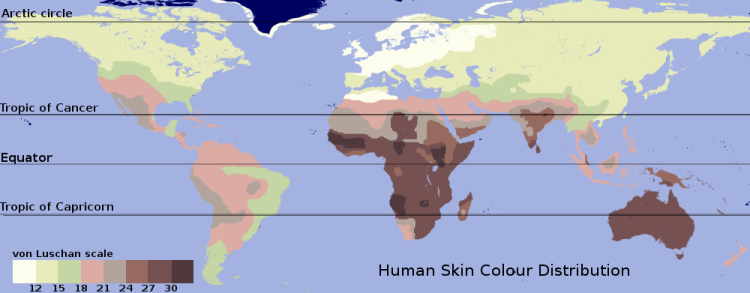 Once again, I will divert to skin pigmentation. In the bottom map, the darker regions have darker skin, and the shade gradually becomes lighter as you move north in latitude; in the top map, you see the distribution of the A allele in the ABO blood group. As you can see, the distribution of skin pigmentation is much different from the distribution of the A allele of the ABO blood group. When you think about it, this isn't all that surprising. Remember, there are multiple different factors driving allele frequency change; mutation, gene flow (and isolation by distance), genetic drift, natural selection, etc. To fully understand this, we need a brief overview of how this evolution works.
Genetic drift and gene flow are evolutionary factors which affect the entire genome. However, at the same time, forces such as natural selection affect only a subset of loci -- in the case of skin pigmentation, the genes involved in the synthesis of melanin. Thus, different traits (and at the genetic level, different loci) can have very different evolutionary histories. So if the concept of race doesn't work usefully for humans, how can we study, in a meaningful way, the biological variation observed in our species?
As detailed, the current study of human variation is an evolutionary one. We try to understand how different evolutionary factors have shaped the diversity of our species. This approach has to be very flexible, since there are many ways to proceed depending on which evolutionary questions we want to answer. Now, we will identify different ways anthropologists study human variation.
Some researchers study human variation at the level of local populations; for example, studies of the social structure and genetics of South American Indians of the rain forest. Other anthropologists study human variation at the level of global major geographic regions; for example, in the most relevant case of Lewontin, studying the patterns of variation within and between major continental groups. We will soon get into the significance of Lewontin's findings, but for now, let us consider two more examples.
Many anthropologists attempt to understand population history using as many traits as possible; for example, studies of gene flow in New World populations. Others are primarily interested in specific traits, trying to understand how evolutionary factors have shaped the variation in those traits in human populations. We have already discussed an example of this: the study of the distribution of skin pigmentation genes and their evolutionary history.
These are examples of the different ways in which anthropologists can study human variation. For decades, anthropologists have tried to answer two important questions related to this topic: what is the extent of variation in human populations, and how is this variation distributed (are there many differences between major geographic groups)? The answers to these questions can be found by studying our DNA.

As briefly mentioned earlier, most molecular anthropologists and human geneticists think that the low diversity observed in humans is due to our recent origin. Anatomically modern humans are a young species, so the level of diversity is relatively low. In addition, there is evidence indicating that humans went through a severe bottleneck in their history -- in other words, the human population was reduced to a few thousand people; however, not everyone agrees about the origins of anatomically modern humans (the very large consensus up until now has supported the Out of Africa hypothesis, but recently the multiregional hypothesis [not to be confused with the candelabra model] has found favor among many anthropologists, including myself; I won't get into this now, I simply wish to identify the two most significant sides of the debate).
But now that we've gone into general perspective of variation of humans, we can get into variation within and between, as promised. We have seen that at the genetic level, humans show less variation than the great apes. There are other important questions regarding human variation, however:
- How is the variation distributed?
- How much variation exists within our populations?
- How much variation exists between, particularly at the continental level?
For this, let's review the evidence at the DNA level and see if we can find an answer.
Now, we move on to our guest of honor again. One of the first researchers to estimate the relative degree of genetic variation within and between human populations was Lewontin in 1972. Since his original study, many more have been carried out, using different methodologies and different genetic markers. All of these studies generally show that the percentage of genetic variation between continental groups is only a small percentage of the total variation -- most of the variation is found within populations. As stated earlier, numerous studies indicate that the percentage of genetic variation between continental groups only accounts for about 5% - 15% of the total. Again, this is probably due to the recent origin of our species, plus the effect that gene flow has had in shaping our genetic diversity.
But how do we interpret the results? How can we reconcile the obvious differences we observe in anthropometric traits between human populations with the low values observed at the genetic level? This, apparently, would be a contradiction, but it isn't so. Consider again the factors driving human evolution. Although most traits show very small differences between human populations, some traits can show large differences, particularly those subjected to strong diversifying selection. To help you understand this better, let's clarify some important points.
The estimate of variation between human populations (FST = 0.05 - 0.15) is an average value. The dispersion of FST values around the mean is wide. While the majority of markers show low FST values (FST = <0.15), some markers can have large FST values, and the results of such studies of genetic markers can and will vary. When you can, take a closer look at the FST distribution of
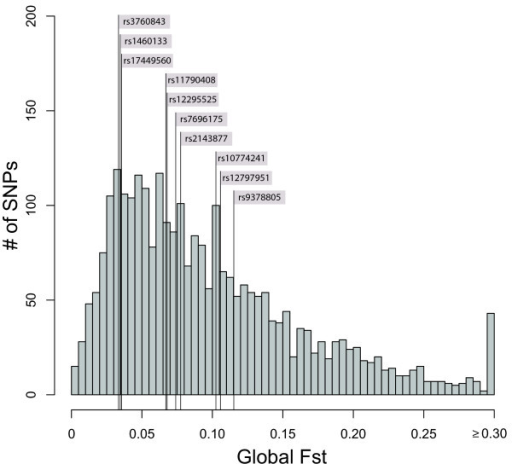 |
| Only 2,750 markers, but you can still see the wide variation. |
Typological racial classifications do not capture the complex pattern of diversity found in human populations. Humans show low genetic diversity in comparison with great apes. Most of the genetic variation found in humans is within populations. In addition to mutation, gene flow, genetic drift and natural selection has also actively shaped our genome, so that for some markers and traits, the differences between populations can be larger than the average (diversifying selection), and for others, the differences may be smaller (stabilizing selection). We are only beginning to understand how these different evolutionary factors have shaped the diversity of our species, but as much as we understand, racial classification is not a useful way to help us to do this; thus, the topic of racial classification, although still much debated, tends to be pushed aside for more useful, productive discussions of explanations for the genetic variation we find in the human species.
In the end, Lewontin may have committed a fallacy by concluding all of this from the premises he had, but he ended up being right regardless.
Thank you for reading.
*For supplementary reading, I recommend looking at the module set by the General Anthropological Division of the American Anthropological Association: http://www.aaanet.org/committees/commissions/aec/gad_module_2.pdf
I would also recommend "Race Reconciled: How Biological Anthropologists View Human Variation."
Follow me on social media!
Twitter: https://twitter.com/AlexisDelanoir
Google+: https://plus.google.com/+AlexisDelanoir0/
YouTube: https://www.youtube.com/AlexisDelanoir
Edwards, A. (2003). Human genetic diversity: Lewontin's fallacy. BioEssays, 25 (8), 798-801 DOI: 10.1002/bies.10315
Lewontin, R. (1972). The Apportionment of Human Diversity. Evolutionary Biology DOI: 10.1007/978-1-4684-9063-3_14
Rosenberg, NA. (2002). Genetic structure of human populations. Science.
Subscribe to:
Posts (Atom)