Friday, February 21, 2014

Income Inequality: Jared Taylor and Bad Analyses

American Renaissance is a publication of race realist information, founded by Jared Taylor, an
American journalist. Recently I happened upon a YouTube video uploaded by American Renaissance entitled "Income Inequality: The Debate Ignores Race," with Mr. Taylor as the speaker. The title
immediately struck me as being odd since I'm familiar with the debate over income inequality in America, and race has always been a considered factor. After beginning to watch the video, however, I immediately noticed what Mr. Taylor was attempting to do and, unfortunately for him, nearly all of his assertions were either wrong or misleading. In this post I will be examining some of the arguments he makes, although I will only address maybe the first half of the video. I don't consider this to be something that is completely worth my time, and the video itself is disgusting in nature, but I think it's important to point out where people should be skeptical. My posts serve purposes, and his definitely fits in that motif. So, let us begin.

Jared Taylor
The video begins by giving the warrant for its making: a speech by Obama stating that fighting income inequality and promoting upward mobility is the defining challenge of our time. To begin his argument, Mr. Taylor starts off with this:

"But this talk about fighting income inequality is mostly nonsense. First, inequality is natural; inevitable. People are unequal in every possible way. Not even the most ruthlessly egalitarian regimes run by Stalin, or Mao, or Pol Pot, could enforce across-the-board equality."

First of all, the argument that the fight against income inequality is for "across-the-board equality" is a strawman. It's actually a perfect example of a false dilemma, where Mr. Taylor seems to believe that one must either be supportive of complete and total equality (egalitarianism), or supportive of the natural tenets of inequality (them). Secondly, I don't even think I need to explain, at this point in time, why saying "inequality is natural" is a pointless statement. Of course people are unequal, although not in "every possible way." This is still thinking along the same lines of "you're either one of us, or you're an egalitarian." Let's continue, though.

"And how much equality do we want, anyway? Presumably we don't want everyone in America to get the same grade on the SAT. We want them to get the highest grades they can."

Well we can guess when someone suggests that income inequality is too high, the ultimate goal is to just decrease it by some statistically significant amount. Again, Mr. Taylor reinforces the false dilemma.

"The second obvious blind spot about income inequality is that practically no one points out that for the last twenty or thirty years we have been importing millions of poor people. They then go on to have millions of poor children. This, along with a large native population of blacks, guarantees increasing income inequality. It's scandalous that no one mentions something so obvious."

Actually, the reason nobody brings it up in the manner Mr. Taylor brings it up is because it is obvious, and the answer is almost just as obvious. Importing "millions of poor people" does not necessarily mean that income inequality is going to increase because the Gini coefficient, the statistic we use to measure income inequality, is intended not to scale with a growing population. At the same time, the coefficient also doesn't base inequality strictly off of negotiable funds, but instead also bases it off of any form of capital income -- for example, if a farmer grows his own food, then those crops are considered part of his income. Presumably, the "millions of poor people" coming in who are by and large seeking jobs in agriculture will not so drastically change the coefficient. Also, on the fact of having "millions of poor children," the calculation of income inequality is adjusted for household size. I will admit that adding "millions of poor people" would increase income inequality somewhat, but the coefficient is designed to not allow this type of demographic change to so drastically effect it.

This is upheld when we consider that the influx in immigration was only responsible for 5% of the increase in income inequality from 1980 - 2000. As far as the "large native population of blacks," Mr. Taylor seems only to have confirmed that there is also racial implications in terms of domestic income inequality -- unless, he's suggesting that blacks are somehow predisposed to have lower incomes. Kind of a ridiculous and even more detached assertion than his previous one, but otherwise, it simply upholds that income inequality is an issue. Let's continue.

The chart Mr. Taylor refers to.
For his next claim, Mr. Taylor highlights that the rich are, indeed, getting richer, and cites Figure 2 of the Congressional Budget Office (CBO) report on income inequality in America showing the income gains from 1980 to 2010. He makes note that while income has risen for the top 1% by 201%, nobody has seen a decrease in income, thus "the poor are not getting any poorer."

This is, once again, misleading because of what the CBO accounts for when calculating income inequality. The report makes note of the fact that the statistics also include things such as employer-sponsored health benefits; in other words, as I said, income inequality accounts for any type of capital gain. However, while leaving out such benefits would understate middle- and low-income gains, it gives a different perspective. Intuitively, one could guess that such benefits would make up a smaller percentage of income for the top 1%, but a much larger portion for middle- and low-income households.

In addition, a report from The Pew Charitable Trusts suggests that while the conclusions found by most economists are in concordance with the CBO, that the rich are getting much richer while the poor are still getting somewhat higher incomes (as a result of accounting for all capital), in terms of wealth, it is true that the rich are getting richer, and the poor are getting poorer.

So what does Mr. Taylor say next?

"Remember, however, that these numbers are for households. The rise in income inequality for individuals is considerably less. Well how can that be? It's because so many more people are living in separate households, and a lot of those new households are single mothers with very low incomes. In 1960 the average American household had 3.35 people in it. 10% of those households were headed by a single parent. By 2009 the average household had lost almost a whole person and was down to 2.63 people, and the percentage of single-parent households had tripled to 30%. A huge increase in poor single mothers certainly added a lot to income inequality by household."

Keep in mind that I fully acknowledge that Mr. Taylor doesn't even bother to cite where he's getting these statistics from. For the purposes of this refutation, we're just going to assume that his numbers and assertions are correct. Mr. Taylor still neglects to mention that the CBO in their report of income inequality adjusts for the size of a person's household, such that, for example, a single individual making $20,000 would be scored similarly to a household of four making $40,000.

"People may be envious of sports stars and CEOs with gigantic salaries, but those salaries don't make us poor. Bill Gates didn't get rich by making you poor. He got rich by making software you wanted to buy. Robinson Cano just signed a $240 million contract with the Seattle Mariners because a lot of people want to watch him play baseball. Should there be a law to cut his pay?"

Nobody has anything against Bill Gates. Well, some people do.
It seems Mr. Taylor doesn't understand that when people speak of income inequality, it is largely not concerned with the outliers that are Fortune 500 CEOs and sports stars, since that is a very small portion of what categories we tend to refer to. Literally, if we take the number of athletes and sports competitors and add 500, that accounts for 0.00005% of the United States population -- not even close to addressing the "top 1%" category. Mr. Taylor is very good at noting extremes, but this does not address the large variation that there is between income classes.

"Something that seriously skews incomes in America is the poverty of blacks and Hispanics. [...] The mere presence of blacks and Hispanics, therefore, increases America's income inequality. And this partly explains why the states with the greatest income inequality in 2009 were California and Texas, with their very mixed populations, and the ones with the least income inequality were overwhelmingly white states, such as Maine, Vermont, Montana and Wyoming. The next time someone complains about income inequality, point that out."

Once again, Mr. Taylor makes the same assumption that many others do in saying that because blacks and Hispanics are disproportionately represented in income inequality, that the presence of blacks and Hispanics increases income inequality. This serves only to divide racial lines as opposed to actually explaining the issue. But what of his claims that the more heterogeneous states have higher income inequality?

Let's consult a list of the United States by their Gini coefficients and match them with demographics of US states in the same year, 2010, and calculate a correlation coefficient. Including data from District of Columbia, the correlation is -0.5; in other words, there is a moderate negative correlation between income inequality and the number of white people -- the more white people, the less inequality. The correlation without the District of Columbia was -0.42. Does this hold as strongly if compared to other variables? I decided to do the same test using population density instead of percentage of non-Hispanic whites. Including the District of Columbia, the correlation between high population density per square mile and high income inequality was 0.59. If you remove the District of Columbia, you get -0.43. In both instances, a state's population density is more closely correlated to income inequality than is that state's racial demographics.

Of course, this shouldn't come as much of a surprise -- in a population dense state, job competition is more likely to occur; however, it's obvious that Mr. Taylor would like to neglect stronger correlations in favor of making a racial claim. Even still, I'm probably also ignoring other factors that may have an even stronger correlation.

Income inequality by country.
There is something to say about America's income inequality. If we look at data provided by the United Nations, the World Bank, the CIA and the Organisation for Economic Co-operation and Development, we see that the United States's income inequality is on par with countries we typically deem to be less-than-developed, such as Mexico, and is actually even higher than that of India. This is not an issue of population size, either, as income inequality metrics are independent of population increases, as stated earlier. Later on in the video, Mr. Taylor expresses his disapproval of welfare programs, yet we can see that countries in Scandinavia (known for their strong welfare states) and even Canada (with a public health care system) have lower income inequalities than the US. This is not to say, however, that strong welfare states correlate to lower income inequality, because we can see that China is pretty much in the same range as the United States.

What can we learn from this? It's fairly easy to tell that there are multiple factors that have just as strong, if not a stronger explanation for income inequality in individual states than those mentioned. Mr. Taylor, however, neglects this in the video. Recall what his opening statement was about his views on the debate, in saying: "But this talk about fighting income inequality is mostly nonsense."

Such a dismissive statement of one of something that has been in debate for centuries shows the thinking of a closed-minded, biased individual with no interest in solving problems, but merely pushing his own agenda. I hope that my readers take this as an example that simple solutions to complex problems are almost always biased and crude in nature.

Thank you for reading.


Follow me on social media!

Twitter: https://twitter.com/AlexisDelanoir
Google+: https://plus.google.com/+AlexisDelanoir0/
YouTube: https://www.youtube.com/AlexisDelanoir

Thursday, February 20, 2014

The Importance of a Friend - Revisited

This past August, when I first started my blog, I made an abstract post in which I described the type of relationship I have with my best friend and implicitly show why this is, without a doubt, one of the greatest things someone can have; and more specifically, how my best friend is probably the most important thing I have. However, in keeping with the recent change in how I express myself on this blog, I think the topic deserves revisiting: what is the importance of a friend?

This is the kind of social circle I'm used to.
Of course, the immediate psychological benefits are obvious -- friends offer social support and opportunity for self-disclosure, which is often an important component in the development of self-concept and is necessary for the healthy psychological development of any human being. I say these things from the perspective of a student studying psychology, but these benefits should be intuitively obvious to anyone who has had a good friend in their lives. There are other potential benefits, however, to having stable friendships.

In 2010, Holt-Lunstad, Smith and Layton conducted a meta-analysis of 148 studies, totaling 308,849 participants, to find the association between social relationships on mortality. The results show that on average, strong social relationships confer a 50% increased risk of livelihood, with the strongest association being with complex social integrations (OR = 1.91, or 91%) and the weakest being binary indicators of residential status (OR = 1.19, or 19%). In general, therefore, strong social relationships have a similar influence on mortality as do other established risk-factors for mortality.

Now, I don't know about the rest of you, but concerning situations that involve risk of mortality, I think the effect sizes of having strong social relationships to any degree are enough to start promoting sociability. Not that having a very close circle of a few friends isn't good for the psychological reasons I mentioned, but in terms of longevity, it just doesn't cut it.

Why do I say this? A study by Cable et al. in 2012 observed 3,169 men and 3,512 women born in Great Britain in 1958 and followed them through their life. They found that at age 45, having a smaller network of friends resulted in poorer psychological well-being by age 50. This same study also suggests that men psychologically benefited from larger kinship connections. Maybe there is something to the "mama's boy." I say that in jest, but these results are significant, as they suggest that the network size was an even better predictor of their psychological well-being at age 50 than their previous psychological state or their socio-demographic factors. These results did not differ significantly between men and women.

A similar study conducted by the Centre for Ageing Studies at Flinders University in Australia followed 1,477 people at the age of 70 and found that having a larger network of friends was associated with a 22% increase in longevity compared to those who did not have a large network. At the same time, close relationships with children/relatives did not seem to significantly increase longevity.

So what does this suggest? Get out there and be social!


Follow me on social media!

Twitter: https://twitter.com/AlexisDelanoir
Google+: https://plus.google.com/+AlexisDelanoir0/
YouTube: https://www.youtube.com/AlexisDelanoir


References:

ResearchBlogging.orgHolt-Lunstad, Smith, & Layton (2010). Social Relationships and Mortality Risk: A Meta-analytic Review. PLoS Med DOI: 10.4016/19911.01

Cable et al. (2012). Friends are equally important to men and women, but family matters more for men's well-being. Journal of Epidemiology & Community Health DOI: 10.1136/jech-2012-201113  

Giles et al. (2004). Effect of social networks on 10 year survival in very old Australians: the Australian longitudinal study of aging. Journal of Epidemiology & Community Health DOI: 10.1136/jech.2004.025429

Saturday, February 15, 2014

Gene Variant May Affect Intellectual Ability in Adolescents

It is time to return to specificity to address a recent study that was brought to my attention a few days ago.

4 days ago a study was released entitled "Single nucleotide polymorphism in the neuroplastin locus associates with cortical thickness and intellectual ability in adolescents." The study was conducted by Desrivières and a team of 36 other researches along with the IMAGEN Consortium, published in the Journal of Molecular Psychiatry.

The researchers conducted a large-scale association study in 1,583 adolescents to identify genes which affected cortical thickness. They identified the rs7171755 polymorphism, which acted in cis (oriented on the same side hemisphere) to the expression of the NPTN gene. The results suggest that there is a potential role for regional synaptic dysfunctions in forms of intellectual deficits.

NPTN expression from GeneCards.
Going beyond the abstract, the data was obtained from a sample of 1,583 healthy adolescents, all age 14, obtained from the IMAGEN project -- a project which endorses the study of association between genetics and neural function. Each adolescent was given a verbal and nonverbal IQ score using the Wechsler Intelligence Scale for Children - Fourth Edition (WISC-IV) and SNP genotyping was extracted from whole blood samples. The association between the identified SNP and cortical thickness, verbal IQ and nonverbal IQ were identified using linear regression analyses. Data on NPTN expression was collected from both mice and human brain samples.

The results showed that for the left hemisphere of the brain, the rs7171755 polymorphism on chromosome 15 passed the threshold for significance in affecting cortical thickness; however on the right hemisphere of the brain, while the largest association was found on chromosome 11, none passed the significance threshold, and neither handedness (prior led by the widely-known right/left brain phenomenon) nor ethnicity affected these results. On the left hemisphere, the number of minor alleles at rs7171755 was inversely correlated with mean cortical thickness. The correlation between mean cortical thickness and nonverbal IQ for the left hemisphere was 0.074, and 0.041 for the right hemisphere; also, there was a positive correlation (r = 0.033) between left cortical thickness and school performance. There were no statistically significant correlations between verbal IQ and cortical thickness.

These results suggest that rs7171755 may have a statistically significant influence on nonverbal IQ by affecting cortical thickness. The researchers tested this through mediation analyses and found that the minor A-allele at rs7171755 associated with lower nonverbal IQ scores (β = −1.239); the association was mediated by significant indirect effects on the SNP for nonverbal IQ (β = −0.1851) while direct effects were not significant. There was also a correlation between rs7171755 and verbal IQ scores (β = −1.5048), partially as a result of indirect effects on the SNP on left pars orbitalis thickness, the rest from other factors.

The overall implications of this study suggest that localized effects of rs7171755 on the RPTN gene in brain structure can explain a small amount of the variation in IQ scores (estimate at around 0.5% of the total variation), and this association is found mostly with nonverbal IQ, which leaves the door open for early intervention of adolescent education which would be more conducive to literacy. At the same time, the authors acknowledge the age specificity and low effect size of the study. While normally I am skeptical of such findings, the results of this study suggest to me a realistic potential for association between the rs7171755 polymorphism and IQ scores. It still remains, however, that I am skeptical of the usefulness of IQ scores in measuring intelligence.

In the end, despite some of its shortcomings and the small explanation it suggests, this should be taken as a decent pilot study for further testing of this gene and the associated risk alleles found to be of significance in this study; yet scientists and researchers alike should note that although there is a high heritability estimate for cortical thickness (as noted in the study), it is also greatly susceptible to environmental influences.

Thank you very much for reading.


Follow me on social media!

Twitter: https://twitter.com/AlexisDelanoir
Google+: https://plus.google.com/+AlexisDelanoir0/
YouTube: https://www.youtube.com/AlexisDelanoir


ResearchBlogging.orgReference:

Desrivières et al. (2014). Single nucleotide polymorphism in the neuroplastin locus associates with cortical thickness and intellectual ability in adolescents. Molecular Psychiatry DOI: 10.1038/mp.2013.197


Sunday, February 9, 2014

Specificity versus Generality

The same person who asked me about "Lewontin's Fallacy" in the comment section of my post on Canadian Health Care also asked me a much more open ended question, followed by one that is kind of in the same field. They were as follows:

1) Why do your topics seem to address very specific issues as opposed to large groups of issues. For example, a refutation of a single race realist instead of refuting all of race realism?

2) What political party did you used to affiliate yourself with, and why do you not affiliate with it now?

As I said, these two questions are kind of intertwined, but I believe I can generally answer the second question by addressing the first one.

It seems generally to be true that my topics deal with very specific issues as opposed to general schools of thought. Instead of attacking any specific political party, I specifically address accusations made against Canadian Health Care. Instead of attacking all of radical skepticism, I specifically address topics like global warming (and, although I haven't made a post about it on my blog, water fluoridation). As the Anon pointed, instead of refuting all of race realism, I initially only addressed one race realist. These are all partially as a result of personal interaction -- that is, I made the posts because I had personally encountered the specific debate of those topics -- or a result of chronos. This being said, there are deeper reasons for why I only address specific topics on my blog as opposed to entire schools of thought.

When someone learns the scientific method, they begin to see that it can be applied as a general discipline to many practices. In every day life, it's possible to apply the scientific method in either simple decision making or even as a type of theory for actuary when going shopping for things like skin care products. When doing this, you learn that you can almost never make simple generalizations about groups.

I'm one of those people who believe that groups, in a social context, are illusions. They're mental barriers that associate some people with shared interests and values, but in the end, there are only individuals. This being said, if I were to make a sweeping statement that "the Tea Party (and its members) are ridiculous," I would be ignoring the fact that within that "group" exists a broad range of people with different thoughts and ideas. Individually, however, I can make proper assessments.

Political polarization in the US: The mammoth and the ass.
This isn't the only reason I don't dismiss entire "groups" of people. It's also due to the fact that, at least in my own eyes, I'm not so conceited and closed-minded so as to think that in all cases and at all times, one mindset is better than another, or that a mindset is, with 100% absolute assurance, dismissible and idiotic. If I were to call Democrats idiots, that's dismissing their existence and mindsets in all cases, probably based on only one or two incidents. This coincides with applying the scientific method, because when you use the scientific method, you can't just say "liberals are stupid." You have to look at a situation, examine the suggestions, and find, with all honesty, what is the best resolution to that particular situation. In America, a Democrat may be correct in one place of debate, but a Republican may be correct in another. Issues need to be observed individually, not by generalizations and stereotypes.

This is why I address specific issues. I like to observe different topics of debate, analyze them, collect data, and draw conclusions not from a partisan line, but from the perspective of somebody who actually wants to get things done the way they should be. This is why, in order to answer question #2, I dropped my affiliations with my previous political beliefs.

As I said in my comment, I used to be a minarchist, but for the sake of ease, just label my previous self as being libertarian. Of course, there is much confusion over the libertarian position, and where on the political spectrum they lie, but that only adds to the difficulty of things. While assuming a political position such as this, whenever I observed a situation, I would often find myself asking what the "libertarian solution" to that situation was, not the "best solution." If I skipped that question, I would often times find myself coming to conclusions that would violate, for example, the non-aggression principle. My views of free speech are a sterling example of this (I take an ancient Greek approach to it, such that freedom of speech is allowed but to the extent of public disturbances). The resulting cognitive dissonance was concerning.

So eventually I figured out that declaring partisanship will often just lead one to being intellectually dishonest. Yes, I know, there's nothing special about being an Independent or an Indeterminate, but I feel like all of this needed to be explained.

Of course, this doesn't make me unbiased. Every human being on the planet, I'm willing to bet, is affected by the values and principles they were raised on, and the decisions they make or positions they take are influenced by those things -- "where you stand is based on where you sit." This is inevitable, as it's a part of human nature. All I'm saying is, I'm not afraid to challenge my values if it means finding a better solution. As my dad would say, in this sense, it's very easy to be correct.

This is why I don't have partisan affiliations anymore. It dismisses the scientific method, leads to intellectual dishonesty, and is far too dismissive to be of any practical use.

It's also rather dangerous; in my post on "Lewontin's Fallacy," I came very close to "dismissing" all of race realism, and this resulted in high traffic to my blog from people who were foaming at the mouth, ready to defend their positions, even at the risk of completely ignoring the post they had a contention with. That post is now my most popular, exceeding my second most popular by several hundred views.

Similarly, if I made a post entitled "why anarchists are wrong about everything," I could expect high traffic as well.

I have a busy schedule. I have things I like to do, and life is too stressful to get caught up in these debates which are so polarized that nothing is ever accomplished. Besides the fact that it's dishonest, offensive, and impractical to be partisan, it's just not worth it based on the backlash you'll get from people who take labels as the be-all, end-all definition of a person's identity, personality and concept.

Thank you very much for reading.


Follow me on social media!

Twitter: https://twitter.com/AlexisDelanoir
Google+: https://plus.google.com/+AlexisDelanoir0/
YouTube: https://www.youtube.com/AlexisDelanoir

Wednesday, February 5, 2014

Debate? Why? (Dad's Work)

Just as a forerunner, I'm saddened to reflect on the fact that I've been caught up so much with my own studies and research for the past few weeks that I've neglected to share more of my father's work. This particular piece, in some ways, may have once a juxtaposition with my own values, but I definitely see the validity now. Debating isn't worth much.

-----

I'm beginning to see a pattern in political debates, and I think it speaks to our own behavior as a once-nation. Nobody seems to think they're wrong.

I could cite specific examples, but that isn't what I want to do. All the time, people are arguing or debating about something, and no matter what the case is, it's very rare for me to see either person say "so it seems I was wrong." I don't get much caught up in politics anymore due to this very phenomenon. Candidates, and people in general, have too much pride to admit they're wrong about anything, or they're so firmly attached to their primordial values that to be wrong would to shake their very being.

I mean come on, seriously? Was there ever a point in time where people actually desired to be right?

"Well isn't that the issue?" Not really. What I mean to say is that I wonder if there was ever a point in time where a person didn't desire for their own being to be right, but instead sought the correct information. All people want to be right -- it makes you feel good to have known something over somebody else; but is it that difficult to see that all it takes to be right is to just let go of any potential biases and ask "what the hell is really going on?"

From this perspective, it seems, at least to me, that it's not very hard to be correct. You just need to know when to call it quits.

So when someone says the word "debate," I think to myself, "why bother? There's no point to debating."

"But what if I'm right?"

"Do you know that you are?"

If anybody answers "yes" to that question, then I think they need to work some things out with themselves.

[Of course, this only applies to debatable positions. I wouldn't criticize someone for saying they know they're right when they claim that two and two make four.]


Follow me on social media!

Twitter: https://twitter.com/AlexisDelanoir
Google+: https://plus.google.com/+AlexisDelanoir0/
YouTube: https://www.youtube.com/AlexisDelanoir

Thursday, January 30, 2014

"Lewontin's Fallacy" and Race

[Read before you post! If you comment with a rebuttal that has already been addressed either in the post or in the comments section, your comment will not be approved, and I will most likely bar you from future discussion. If you can't take the time to read the content you're responding to, then you're not welcome on my blog. This is your warning.]

[Note: Spawktalk a.k.a. Sean Last has written a rebuttal to this article for The Right Stuff. You can check it out here. I have opted not to reply since most of the points have been responded to in the comments section of this post, but I would still recommend reading his response, and I've written a reflection on our exchange here.]

I was going to make my next post a work by my father, but since this took me so long, and since my dad encouraged individuals to "do as they see fit, not as they are expected," I went ahead with this post anyway. This is something I've wanted to talk about for a very, very long time, but did not get a legitimate excuse to do so; so, a fair warning: In this post, I will not thoroughly explain the sources I cite (although I can by request), because this post will already take a long time. Instead, I'll include the in-text links as I usually do and continue with my explanation, unless it really is reliant on me to include details of the links I include.

A commenter on one of my other posts asked me a question in regards to something called “Lewontin’s Fallacy” in light of my page on the debate between Sam Owl and LaughingMan0X. In all honesty, in my research of anthropology (and in the nearly a year I’ve spent formally learning the facts), I’ve only ever seen "Lewontin’s Fallacy" mentioned in online arguments. I will still address it, but much more extensively than anticipated. This is a very complex subject, so in order to fully understand the nature of Lewontin’s findings on human genetic variation, I will need to explain the nature of the argument for racial classification for humans, and show why Lewontin, despite committing a fallacy, was actually correct, and where that takes us in the modern realm of anthropology. First, let’s identify what “Lewontin’s Fallacy” actually is, respond to it, and then we will get into the much broader topic. I do this only to satisfy the request of the commenter before rambling on in a subject he or she may not be concerned about looking into at the moment.

"Lewontin's Fallacy" was coined by A.W.F. Edwards in a paper criticizing Richard Lewontin's research in human genetic diversity, specifically his paper "The Apportionment of Human Diversity" from 1972. In this study, Lewontin used single locus analysis to find the fixation index score (or FST) for human beings; in other words, to find what degree of variation there is within human populations and between human populations. He stated that 15% of variation exists between populations, while 85% exists within populations. He concluded, based on this, that the proposal that human races exist is unscientific and meaningless.

A.W.F. Edwards
Edwards's argument was that because Lewontin only uses single locus analysis, he ignored what is largely the consideration for human genetic variation, which would be genetic clusters or multiple loci. By observing genetic clusters, you can find that there are correlations between racial categories and common geographic regions in some cases. Most people cite Rosenberg et al. (2002) or similar studies to substantiate this claim, but this is a gross misrepresentation of the data. Rosenberg et al. tested 1,052 people from 52 populations and used the data in a computer program called Structure. The program asks for a specified cutoff -- how many groups do the researchers want? The researchers actually, with the data they had available, could assign anywhere between 2 and 20 groups. Now, in one discussion I had over this topic, someone pointed out that this is actually a common problem in machine learning -- determining how many clusters are in a data set. This, however, only concedes to the point that genetic cluster analysis does not validate an objective definition of race, because you have to arbitrarily determine what the cutoff is, and what overlaps you're going to ignore in order to determine a degree of dissimilarity. Machine learning should not be the end of scientific inquiry, especially in these cases, because such results still retain a degree of arbitration; one that has to be discussed theoretically and via analysis. I'll get to this later. The 2002 study, if anything, is not evidence for biological race, but evidence that race is a social construction. In fact, in Rosenberg et al. (2005), they state: "Our evidence for clustering should not be taken as evidence of our support of any particular concept of 'biological race.'"

The reality is, genetic variation exists at a continuum across geographic regions (meaning there are no discrete genetic categories). Many anthropologists stop here and say: "if there are no discrete categories, race cannot usefully be applied to humans." Many counter that this is a fallacy of the beard, but therein lies the problem that in human variation, there are no extremities.

"Fallacy of the beard" refers to an analogy about the status of one's beard. The argument would suggest that because you cannot assign a differential category between 100 hairs on a beard from 102 hairs, or so on, that statuses of beard lengths (can be simple as long/short, or can refer to things like five o' clock shadow) do not exist. The reason this is not the case is because beard lengths have extremities, such as being completely clean shaven, implying that while nominal in nature, the partitioning of such categories of beard status rely on the 'number of hairs' in a ratio level of measurement, where there is a meaningful zero (lack of any hairs). This cannot be done for human genetic variation.

Furthermore, for those of you who are looking to defend your stance on race using the information in this post, I would be very wary when people use this argument, because it's actually a clever strawman that you may not catch immediately. Here is another example of how the continuum fallacy goes, from the Wikipedia page:

Q: Does one grain of wheat form a heap?
A: No.
Q: If we add one, do two grains of wheat form a heap?
A: No.
[...]
Q: If we add one, do one hundred grains of wheat form a heap?
A: No.
Q: No matter how many grains of wheat we add, we will never have a heap; therefore, heaps don't exist!

That last line is where the argument may slip you up. Anthropologists, by and large, do not take the position that race does not exist, but instead that race is subjectively classified, and relies more on the societal context you find it as opposed to any real biological differences. Race does exist, it's just subjective; therefore, arguing that this is a continuum fallacy is a strawman, and cannot be applied.

There are some important facts to note here. Although Lewontin drew his conclusion hastily from his premise (that because humans have more variation within than between populations, then races don't exist), genetic studies have upheld his findings for the most part. In fact, Lewontin's premise wasn't inaccurate at all. The average FST of humans does tend to be between 0.05 and 0.15 (although the Rosenberg study sets it at a smaller number, and the Excoffier/Hamilton study sets it at a larger number, the number I refer to is what is generally accepted and is not up for much debate). His "more variation within than between" finding continues to be echoed in the field of anthropology not for the conclusions that he drew, but for the fact that he did successfully fixate the populations of humans on the index. Lewontin's "fallacy" was not in the fixation index, but the conclusion he drew from it -- that races don't exist. No anthropologist really denies the empirical findings of Lewontin's research, but the debate over the existence of objectively defined human races still continues to this day.

There is variation. Now what?
The argument now is in the hands of anthropologists. There exists approximately 15% variation
between human populations, so what does this mean for race? Are these genetic differences significant or not? For the rest of this post, I will be applying the information I have mentioned above to a larger topic: the extent, the pattern, and the meaning of variation in modern humans, as well as historic attempts to understand this diversity. This will take a long time, so I encourage my readers to be patient and feel free to come to and from this post as frequently as what makes you feel comfortable.

Firstly, in terms of evolutionary time, 60 kya (about 60,000 years) is a very short time. That's the estimate that we generally use for the age of modern humans. Starting 60,000 years ago, anatomically modern humans began to expand and occupy every region of the planet, leading us to where we are today. The world is very ecologically diverse, and so various human populations encountered different ecological and climatic conditions. The extent of how far modern human migration has gone can easily be seen in places such as (let me use the expected example) Toronto. This type of diversity comes primarily from our current period of time.

Attempts to understand human diversity go back thousands of years. Yet, one of the first "scientific" attempts to classify humans according to their physical characteristics was by Carolus Linnaeus, who we now know as the founder of modern taxonomic classification. He invented the binomial classification system of genus/species that we continue to use to this day. Once again, this was an effort that goes back thousands of years. For this reason, it's very instructive to review Linnaeus's early classifications of humans based on their observable characteristics. In 1758, Linnaeus essentially used the following classifications and descriptions for each:

Americanus: reddish, choleric, and erect; hair black, straight, thick; wide nostrils, scanty bearrd; obstinate, merry, free; paints himself with fine red lines; regulated by customs

Asiaticus: sallow, melancholy, stiff; hair black; dark eyes; severe, haughty, avaricious; covered with loose garments; ruled by opinions 

Africanus: black, phlegmatic, relaxed; hair black, frizzled; skin silky; nose flat; lips tumid; women without shame, they lactate profusely; crafty, indolent, negligent; anoints himself with grease; governed by caprice

Europeaeus: white, sanguine, muscular; hair long, flowing; eyes blue; gentle, acute, inventive; covers himself with close vestments; governed by laws
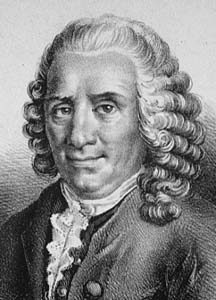
 
Carolus Linnaeus
Already, it may have struck you that there are many issues with the Linnaen classification of humans. Firstly, he relies on superficial facial/cranial traits such as skin color, hair color, eye color, and so on. In addition, the broadly defined groups rely on the 18th century Eurocentric preconceptions of surrounding regions, with culturally loaded classifications as well. It is based on perception of the groups from that period of time, and from the perspective that Linnaeus had as a Swedish scientist. At the same time, as I noted to one of my professors, it seems that the Linnaen classification of humans may have been influenced by his experience as a botanist -- he categorized humans, as it seems, according to obvious physical characteristics, and then by attempting to observe how they interact with the environment they're found in. Feel free to disagree with this observation, but now, most of us (with the exception of Eurocentrics) see Linnaeus's classification as being pretty ridiculous, but it has taken us a long time to get where we are today in objectively analyzing the classification of human groups.

Similarly, in 1775, Johann Friedrich Blumenbach submitted his thesis for his M.D. entitled De generis humani varietate nativa (or, On the Natural Variety of Mankind). He is now considered to be the father of physical anthropology, and with good reason. Blumenbach, like Linnaeus, assigned to humans five categories representing their types:

Mongolian (yellow)
American (red)
Caucasian (white)
Malayan (brown)
Ethiopian (black)

In classifying these, Blumenbach used a more biological approach in contrast to Linnaeus. At the same time, Blumenbach rejected the notion of multiple human origins, and also rejected the notion of African inferiority from an anthropological perspective. He also recognized the continuous nature of human variation. This is why we consider him to be the father of physical anthropology: his findings have been the basis for studies in this field of science to this day. However, as I said, the classification of human races still remains in debate.

To understand this debate, we have to ask "what is race?" This can be problematic because the term means different things to different people; for some it has a strict biological meaning, for some a cultural meaning, and for some a combination of the two. Here, we will try to observe it strictly by its biological validity. There comes an issue, however: how can we define race in a narrow biological sense? Do these races exist in humans? Can race usefully explain the biological variation found in humans?

The term "race" was officially coined by Comte de Buffon, a French naturalist, in 1745, but one of the first scientists to use the term "race" in its modern context was the French physician and traveler Francois Bernier in his 1684 publication Nouvelle division de la terre par les différentes espèces ou races qui l'habitent, or New division of Earth by the different species or races which inhabit it. Here we see that he used "species" and "race" as being somewhat synonymous, so how will we define it knowing what we do in the modern realm of anthropology?

AAA and others: thank you for your hard work.
Race could be defined as "unambiguous, clearly demarcated, biologically distinct groups." It could also be defined as "a division of a species that differs from other divisions by the frequency with which certain hereditary traits appear among its members." Do either of these definitions apply to humans? If we use the former definition, the American Anthropological Association (AAA) made a statement on the existence of human races. In addition, the American Association of Physical Anthropologists (AAPA) made a statement as well. Lastly, the Human Genome Project (HGP), the largest and probably one of the most significant projects undertaken to decode the human genome, one which will be remembered in the scientific community for centuries, also released their statement on the existence of human race/ethnicity.

There are many reasons why the AAA, the AAPA and the HGP came to these conclusions. As we have established, races are, by definition, discrete and unambiguous units of classification which are used to explain variation which is mostly continuous in nature. It's important to note, before continuing, that evolution is very complex, and there are many different factors that can influence that variation. The variation in humans, and any species of animal, can be described with their interplay with evolutionary factors.

Consequently, racial classifications can't explain, in any meaningful way, the variation observed in human populations -- this is why there has never been any true agreement among anthropologists on the number of races, from three to several dozen. Before half of my audience pulls up their mouse and diverts to the comment section, this does not mean I am denying that there is biological variation in humans. As Relethford stated in 2002, "biological variation is real; the order we impose on this variation by using the concept of race is not." We are not all the same, the variation is undeniably there; however, creating descriptive categories for humans fails to explain the complex reality of human variation.

Let me use the example of skin pigmentation. There are simplistic views as alluded to above: red, yellow, white, brown, black. Then there is the more complex, realistic view: there is going to be a huge range of variation in skin tone, and there will inevitably be overlaps between groups. The traits that have traditionally been employed to classify humans in "racial" groups are anthropometric traits (primarily skin color, facial features, shape and size of head and body, underlying skeleton, etc. as shown by the Linnaen classification, for example). However, anthropometric traits are strongly influenced by the environment and are subject to natural selection, which may be acting in different ways for different traits. This being said, natural selection acts in specific genomes, thus different traits often shown remarkably discordant geographical distributions.

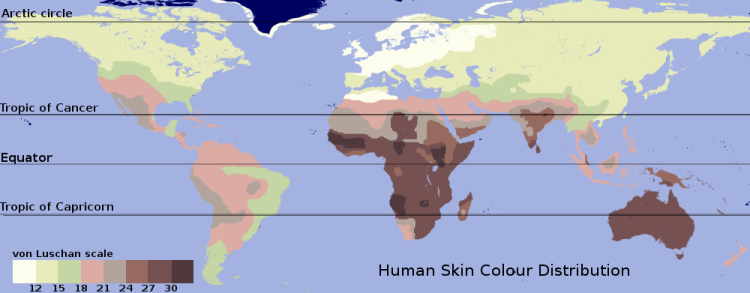
Once again, I will divert to skin pigmentation. In the bottom map, the darker regions have darker skin, and the shade gradually becomes lighter as you move north in latitude; in the top map, you see the distribution of the A allele in the ABO blood group. As you can see, the distribution of skin pigmentation is much different from the distribution of the A allele of the ABO blood group. When you think about it, this isn't all that surprising. Remember, there are multiple different factors driving allele frequency change; mutation, gene flow (and isolation by distance), genetic drift, natural selection, etc. To fully understand this, we need a brief overview of how this evolution works.

Genetic drift and gene flow are evolutionary factors which affect the entire genome. However, at the same time, forces such as natural selection affect only a subset of loci -- in the case of skin pigmentation, the genes involved in the synthesis of melanin. Thus, different traits (and at the genetic level, different loci) can have very different evolutionary histories. So if the concept of race doesn't work usefully for humans, how can we study, in a meaningful way, the biological variation observed in our species?

As detailed, the current study of human variation is an evolutionary one. We try to understand how different evolutionary factors have shaped the diversity of our species. This approach has to be very flexible, since there are many ways to proceed depending on which evolutionary questions we want to answer. Now, we will identify different ways anthropologists study human variation.

Some researchers study human variation at the level of local populations; for example, studies of the social structure and genetics of South American Indians of the rain forest. Other anthropologists study human variation at the level of global major geographic regions; for example, in the most relevant case of Lewontin, studying the patterns of variation within and between major continental groups. We will soon get into the significance of Lewontin's findings, but for now, let us consider two more examples.

Many anthropologists attempt to understand population history using as many traits as possible; for example, studies of gene flow in New World populations. Others are primarily interested in specific traits, trying to understand how evolutionary factors have shaped the variation in those traits in human populations. We have already discussed an example of this: the study of the distribution of skin pigmentation genes and their evolutionary history.

These are examples of the different ways in which anthropologists can study human variation. For decades, anthropologists have tried to answer two important questions related to this topic: what is the extent of variation in human populations, and how is this variation distributed (are there many differences between major geographic groups)? The answers to these questions can be found by studying our DNA.

In spite of the seemingly high variation observed in humans for some anthropometric traits (skin color, shape/size of head/body, etc.), humans show little-to-moderate variation at the genetic level, as alluded to earlier. It is particularly interesting to contrast the genetic diversity observed in humans with that of our closest relatives, the great apes. It turns out that at the DNA level (Y chromosome, mtDNA, and autosomes) humans are much less diverse than the great apes. Consider the chart on the right that I pulled from an anthropology textbook, illustrating the diversity that exists within our populations using Watterson's diversity estimator. It shows that at the genetic level, humans have a diversity level of about 7.5, while chimps lie at 24, gorillas 15, and orangutans 25. Why is there so little variation in humans compared to our hairy relatives?

As briefly mentioned earlier, most molecular anthropologists and human geneticists think that the low diversity observed in humans is due to our recent origin. Anatomically modern humans are a young species, so the level of diversity is relatively low. In addition, there is evidence indicating that humans went through a severe bottleneck in their history -- in other words, the human population was reduced to a few thousand people; however, not everyone agrees about the origins of anatomically modern humans (the very large consensus up until now has supported the Out of Africa hypothesis, but recently the multiregional hypothesis [not to be confused with the candelabra model] has found favor among many anthropologists, including myself; I won't get into this now, I simply wish to identify the two most significant sides of the debate).

But now that we've gone into general perspective of variation of humans, we can get into variation within and between, as promised. We have seen that at the genetic level, humans show less variation than the great apes. There are other important questions regarding human variation, however:

- How is the variation distributed?
- How much variation exists within our populations?
- How much variation exists between, particularly at the continental level?

For this, let's review the evidence at the DNA level and see if we can find an answer.

To measure variation within and between populations, the most common statistic is the fixation index, or FST. FST measures the amount of differentiation between groups or populations. An example is the picture shown on the left. It explains the basic mechanisms of calculating the variation between vs. within populations. In humans, there are few genetic markers that have huge genetic differences between populations.

Now, we move on to our guest of honor again. One of the first researchers to estimate the relative degree of genetic variation within and between human populations was Lewontin in 1972. Since his original study, many more have been carried out, using different methodologies and different genetic markers. All of these studies generally show that the percentage of genetic variation between continental groups is only a small percentage of the total variation -- most of the variation is found within populations. As stated earlier, numerous studies indicate that the percentage of genetic variation between continental groups only accounts for about 5% - 15% of the total. Again, this is probably due to the recent origin of our species, plus the effect that gene flow has had in shaping our genetic diversity.

But how do we interpret the results? How can we reconcile the obvious differences we observe in anthropometric traits between human populations with the low values observed at the genetic level? This, apparently, would be a contradiction, but it isn't so. Consider again the factors driving human evolution. Although most traits show very small differences between human populations, some traits can show large differences, particularly those subjected to strong diversifying selection. To help you understand this better, let's clarify some important points.

The estimate of variation between human populations (FST = 0.05 - 0.15) is an average value. The dispersion of FST values around the mean is wide. While the majority of markers show low FST values (FST = <0.15), some markers can have large FST values, and the results of such studies of genetic markers can and will vary. When you can, take a closer look at the FST distribution of
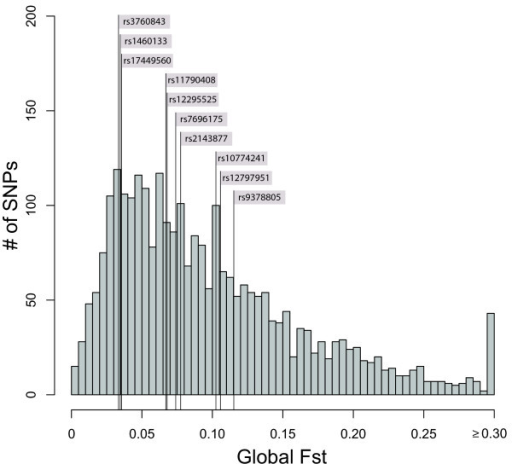
Only 2,750 markers, but you can still see the wide variation.
approximately 10,000 markers in the human genome. Remember, the reality is almost always more complex than we think. You can see that although most markers show small differences between human populations, the distribution around the mean is very wide. Some of the traits showing large differences between populations are the traits that have traditionally been used to infer racial classifications. Those traits do not represent the average picture at the genomic level, and thus even if we could somehow agree on racial classifications for humans, it would not be very meaningful, because it would not help us understand the large majority of human genetic variation.

Typological racial classifications do not capture the complex pattern of diversity found in human populations. Humans show low genetic diversity in comparison with great apes. Most of the genetic variation found in humans is within populations. In addition to mutation, gene flow, genetic drift and natural selection has also actively shaped our genome, so that for some markers and traits, the differences between populations can be larger than the average (diversifying selection), and for others, the differences may be smaller (stabilizing selection). We are only beginning to understand how these different evolutionary factors have shaped the diversity of our species, but as much as we understand, racial classification is not a useful way to help us to do this; thus, the topic of racial classification, although still much debated, tends to be pushed aside for more useful, productive discussions of explanations for the genetic variation we find in the human species.

In the end, Lewontin may have committed a fallacy by concluding all of this from the premises he had, but he ended up being right regardless.

Thank you for reading.

*For supplementary reading, I recommend looking at the module set by the General Anthropological Division of the American Anthropological Association: http://www.aaanet.org/committees/commissions/aec/gad_module_2.pdf

I would also recommend "Race Reconciled: How Biological Anthropologists View Human Variation."


Follow me on social media!

Twitter: https://twitter.com/AlexisDelanoir
Google+: https://plus.google.com/+AlexisDelanoir0/
YouTube: https://www.youtube.com/AlexisDelanoir


ResearchBlogging.orgEdwards, A. (2003). Human genetic diversity: Lewontin's fallacy. BioEssays, 25 (8), 798-801 DOI: 10.1002/bies.10315  

Lewontin, R. (1972). The Apportionment of Human Diversity. Evolutionary Biology DOI: 10.1007/978-1-4684-9063-3_14

Rosenberg, NA. (2002). Genetic structure of human populations. Science.

Tuesday, January 28, 2014

Canadian Health Care and Why Americans "Can't Politics"

In this post, I will be discussing common misconceptions of the Canadian health care system. Perhaps the title of this post is too generalizing and offensive, but allow me to defend my position. Anyone in America who watches the news somewhat frequently knows of the arguments I will be referring to, and many of you will be aligned with this sort of thinking. At the same time, I acknowledge that the vast majority of Canadians who are familiar with our health care system do not need to be informed of these facts, although they may be familiar with the debate in America, and that many Americans are also not aligned with these thoughts. My goal here primarily is to address individuals residing in America who have been socialized with the misinformation being passed around in their common media about Canada's health care system, and similar systems in general. Hopefully I can successfully unhinge a few people from their fears of a single-payer health care system.

As I said above, I acknowledge that most Canadians know the facts already, but this goes into a deeper issue within this topic, and is quite relevant. In November of 2009, Nanos Research conducted a poll of 1,005 Canadians by telephone to find their opinions of our health care system. It was found that 79.9% give their endorsement of the health care system, while about 10% are still somewhat supportive, amounting to a general ~90% approval rating. The strongest approval rating was 83% in Ontario, my province, while there exists no significant regional variation. Please note, before I continue, that this is the unqualified opinion of Canadian citizens, not professionals in the medical field. We'll get to that later.

This same poll asked a question about the Canadian citizens' opinion of United States President Barack Obama's endorsement and pursuit of a public health care system. 71.3% expressed that they believe Barack Obama is "on the right track," while only 7.3% stated disapproval. The rest were unsure, which is to be expected. Again, the highest rate of approval was found in Ontario.

So everyone can see the specific results.
So now that we've established that most Canadians approve of public health care, I want to take a moment to be fair to the other side. Most Americans will refer to the fact that Canadians evidently report of extreme waiting times for procedures and operations. The same poll conducted above asked two specific opinionated questions. The first question asks what Canadians think is the key strength of our health care system. 61.4% answered that it was free public health care that was accessible to everyone. The second question asked what we think is the weakest aspect. Consistent with the opposition's claims, 32.7% responded that waiting times/lack of accessibility were the biggest issues. Note, this does not mean that 32.7% of Canadians believe there are outrageous waiting times -- just that if they had to pick, this would be the primary issue.

Waiting times are not the only factor that might lead Canadians to come to America to receive health care. Canada is actually behind in terms of new technology for certain procedures, such as cranial tumors or brain injury. Sometimes hospitals are in more convenient locations as well for Canadians living close to the border, and American hospitals, as it seems to me, are generally superior, especially because of the greater numbers in staff.

However, despite these contentions, it doesn't imply that the article linked at the beginning of this post is assuming correctly. In fact, all of the possibilities I listed above have been found to have little-to-no effect on Canadians traveling outside of Canada for medical treatment. A study conducted by Katz et al. in 2002 examined Canadians traveling to the United States for such purposes. They used data from the National Population Health Survey (NPHS) to find survey responses to two questions. The first question asked if the respondent received medical care in the United States during the past twelve months of their response. If the respondent answered "yes," the next question asked if they went to the United States primarily for such services.

They also collected data by contacting, via telephone, all ambulatory care facilities located in the United States close to the Canadian border in densely populated areas. The reason for this was to get the most accurate response, since it is assumed that if Canadians were to go to the United States for medical treatment, they would choose a location close to Canada. They asked key informants within these institutions for the number of Canadians they had seen in the prior year, and to indicate any significant trend.

Lastly, they contacted statewide hospital discharge data from 136 ambulatory care facilities in New York, Michigan and Washington, asking how many Canadians they admitted into the hospital according to admission status (and not by coincidental activity). They also selected for "America's Best Hospitals" to find a relevant trend. The results were as follows:

Approximately 40% of facilities contacted had seen no Canadians in the prior twelve months, 40% had seen fewer than ten, 15% had treated 10 - 25 patients, and 5% reported seeing more than 25 (although none reported seeing more than 100, the number was generally between 25 and 75). If we extrapolate the data, there were 640 Canadians who received treatment for diagnostic radiology services and 270 patients for eye procedures in America over that year. However, in British Columbia over a 5-year period, there were 80,000 and 25,000 procedures respectively, and for Quebec, 375,000 and 44,000 procedures respectively. It is important to note that this comparison is extrapolated, and the comparison is between two five-year periods and the study's one-year period; however, at the same time, we must consider that the comparison is only being made to two regions of Canada.

In the three states observed for hospital discharge data, ~4,500 Canadians received treatment; however, approximately 80% of such treatment was related to pregnancy.

For the NPHS results, of the 18,000 respondents in 1996, only 90 said they had received treatment in the United States, and of those, only 20 stated they went to America expressly to do so.

Some of these visits, notably, were as a result of contract provisions. In October of 1999, Quebec contracted with three radiation centers in Vermont and Maine. In the subsequent year, 1,030 patients were treated. Ontario did the same in March of 1999 with three health care organizations in Michigan, New York and Ohio. Subsequently, 1,416 patients were treated. This already accounts for about 8.5% of prostate and breast cancer patients from Canada during that time frame.

Robbed from the AARP debunk article.
So in summation, only 5% of the examined facilities saw a significant number of Canadian patients, and ~0.11% of Canadians go to America for medical treatment. This suggests that while Canadians have contentions with the health care system, a very small number come to America for their procedures, and most Canadians do approve of the health care system. The reason is because the waiting times have nothing to do with the fact that Canada uses a single-payer system. It has to deal with what percentage of the country's GDP is spent on health care.

For Canada, it's 9.9%, according to the Organization for Economic Cooperation and Development (OECD) in 2004. For the United States, it's 15.3%. This is something intuitively obvious to people familiar with economics. Simply put, the less money people spend on medical services, the more likely they are to be restricted on their access to those services. This same principle applies to many fields.

So, Canadians approve of the health care system, because the waiting times are irrelevant to the type of system. But what of Canadian physicians?

Sampling and other data.
As I mentioned of the Nanos Research study, the poll only asked in regards to public opinion; however, another poll was conducted by Schoen et al. in 2009 to find opinions of physicians from 11 countries in regards to their satisfaction in their practice. There were 1,401 responses in Canada and 1,442 in the United States. Of the physicians in Canada, approximately 54% expressed satisfaction, and 21% said they were very satisfied. In the United States, 49% said they were satisfied, while 15% said they were very satisfied. So it seems there is not much of a significant difference between the two approval ratings; although, the rating is higher in Canada.

Both Canadian citizens and Canadian physicians enjoy the health care system for the most part. This was never anything complicated, but sometimes, it takes some true data to get rid of any misconceptions. When political agendas are in mind, it's very difficult not to make comparisons, and often times, these comparisons are faulty. There are plenty of countries which are satisfied with public health insurance (just look at Scandinavia), and there are plenty which are satisfied with either a combination of public and private, or just private. We can't just dismiss an entire system and say "it doesn't work," because so many variables are involved in whether or not a system works. The system itself isn't always at fault, and even if it were in one country, that says nothing about how it would work for another. This is a vital principle of politics in general -- context.

I've lived in America for most of my life (more than I have in Canada; in fact, I've barely spent more of my life in Canada than Japan). I'm familiar with the politics. It's hard to say whether one system will be better than another, but all I can say is, it just takes honest consideration as opposed to terrorizing buzzwords like "socialism." Things like this are very dangerous, because they divert to simple ideological differences as opposed to arguments over practical application. This is much of the reason why I have dropped any explicit affiliation with a political party (or "faction" if you're an early democratic or a Marxist). I plan to make my next post a work by my father, but in the future, I'll make a post about my views on politics in general.

Until then, thank you for reading.

*If you want to see the AARP's version, which has a lot of the information I used in my post, follow this link.


Follow me on social media!

Twitter: https://twitter.com/AlexisDelanoir
Google+: https://plus.google.com/+AlexisDelanoir0/
YouTube: https://www.youtube.com/AlexisDelanoir